Loretta reports:
"Men don't make passes at girls who wear glasses." Marilyn Monroe pointed this out in How to Marry a Millionaire, while contriving to look as sexy and glamorous as ever in her spectacles.
Here's advice on choosing the right eyeglasses in the 1950s.
Readers who receive our blog via email might see only a black rectangle where the video ought to be. To watch the video, please click on this link to the Two Nerdy History Girls blog.
Showing posts with label medical matters. Show all posts
Thursday, February 2, 2012
Wednesday, January 11, 2012
Dealing with rheumatism & gout in 1834
![]() |
| Garlic |
Last week, in response to my blog about curing gout with heavy drinking, a commenter expressed curiosity about treatments in the past for these ailments.
These two home remedies dating to 1834 (and let’s remember that many people never saw a doctor in their lives) came from one of my favorite sources, The New Female Instructor or Young Woman’s Guide to Domestic Happiness, a book I’ve cited before (here & here).
~~~
Receipt for the Rheumatism.
Take of garlic two cloves, of ammoniac one drachm: blend them, by bruising, together; make them into two or three bolusses, with fair water, and swallow them, one at night, and one in the morning. Drink, while taking this medicine, sassafras tea, made very strong, so as to have the teapot filled with chips. This is general found to banish the rheumatism, and even contractions of the joints, in a few times taking.Remedy for the Gout.
![]() | |||
| Gum Ammoniac |
Illustrations courtesy Wikimedia Commons. Clicking on captions will take you to the Wiki page.
Sunday, January 1, 2012
A cure for rheumatism or gout
![]() |
| Gillray, The Gout |
Welcome back, readers! We hope you had fine holidays, and return to us refreshed, eager for another year of unbridled historical nerdiness.
We begin 2012 with a holiday that may be unknown to many of our readers, and an infallible cure for gout or rheumatism, courtesy Mr. William Hone’s Every-day Book, whose full title you'll find below.
~~~
The first Monday after new year's day is called Handsel Monday in some parts of Scotland, and is observed by merrymaking. In sir J. Sinclair's " Statistical Account," it is related of one William Hunter, a collier, that he was cured in the year 1758 of an inveterate rheumatism or gout, by drinking freely of new ale, full of barm or yeast. "The poor man had been confined to his bed for a year and a half, having almost entirely lost the use of his limbs. On the evening of Handsel Monday, as it is called, some of his neighbours came to make merry with him. Though he could not rise, yet he always took his share of the ale, as it passed round the company; and, in the end, became much intoxicated. The consequence was, that he had the use of his limbs the next morning, and was able to walk about. He lived more than twenty years after this, and never had the smallest return of his old complaint." This is a fact worth remembering, as connected with chronical complaints.![]() |
| Rowlandson, Gouty Gourmands |
pastimes, ceremonies, manners, customs, and events, incident to each of the three hundred and sixty-five days, in past and present times; forming a complete history of the year, months, and seasons, and a perpetual key to the almanac including accounts of the weather, rules for health and conduct, remarkable and important anecdotes, facts, and notices, in chronology, antiquities, topography, biography, natural history, art, science, and general literature; derived from the most authentic sources, and valuable original communications, with poetical elucidations, for daily use and diversion, Volume 1, 1827 (the Google edition is 1838).
Illustrations:
James Gillray, The Gout, 1799, courtesy Wikimedia Commons.
Thomas Rowlandson, Comforts of Bath, Gouty Gourmands at Dinner, 1798, courtesy Yale Center for British Art, Paul Mellon Collection.
Monday, July 11, 2011
"Few virtues are of more importance to society": Cleanliness & Dr. Buchan, 1769
Susan reporting:
Seeing Queen Caroline's bath yesterday reminded me of Dr. William Buchan (1729-1805), left, last mentioned on this blog here discussing the importance of healthy perspiration. This Scottish physician became a household name in 18th c. Great Britain by writing one of the earliest bestsellers of medical advice, a straightforward volume that became the standard reference in thousands of homes. Domestic Medicine: or, A Treatise on the Prevention & Cure of Diseases by Regimen and Simple Medicines was first published in 1769, and went on to be reprinted over and over throughout the 18th and 19th c., selling an estimated 80,000 copies. Dr. Buchan was a firm believer in cleanliness and washing as promoting good health, as this excerpt demonstrates:
"Frequent washing not only removes the filth and sordes which adhere to the skin, but likewise promotes the perspiration, braces the body, and enlivens the spirits. How refreshed, how cheerful, and agreeable does one feel on being shaved, washed, and shifted, especially when these offices have been neglected longer than usual!.... Cleanliness is certainly agreeable to our nature. We cannot help approving it in others, even though we should not practice it ourselves. It sooner attracts our regard than even finery itself, and often gains esteem where that fails. It is an ornament to the highest as well as the lowest station, and cannot be dispensed with in either. Few virtues are of more importance to society than general cleanliness. It ought to be carefully cultivated everywhere; but in populous cities, it should be almost revered."
Did all of Dr. Buchan's readers follow his excellent advice regarding cleanliness? Probably not. But then, how many modern readers of doctor-written bestsellers are following similar excellent advice regarding diet, exercise, and plenty of sleep?
Above: William Buchan, M.D., frontispiece from 1805 edition of Domestic Medicine.
Seeing Queen Caroline's bath yesterday reminded me of Dr. William Buchan (1729-1805), left, last mentioned on this blog here discussing the importance of healthy perspiration. This Scottish physician became a household name in 18th c. Great Britain by writing one of the earliest bestsellers of medical advice, a straightforward volume that became the standard reference in thousands of homes. Domestic Medicine: or, A Treatise on the Prevention & Cure of Diseases by Regimen and Simple Medicines was first published in 1769, and went on to be reprinted over and over throughout the 18th and 19th c., selling an estimated 80,000 copies. Dr. Buchan was a firm believer in cleanliness and washing as promoting good health, as this excerpt demonstrates:
"Frequent washing not only removes the filth and sordes which adhere to the skin, but likewise promotes the perspiration, braces the body, and enlivens the spirits. How refreshed, how cheerful, and agreeable does one feel on being shaved, washed, and shifted, especially when these offices have been neglected longer than usual!.... Cleanliness is certainly agreeable to our nature. We cannot help approving it in others, even though we should not practice it ourselves. It sooner attracts our regard than even finery itself, and often gains esteem where that fails. It is an ornament to the highest as well as the lowest station, and cannot be dispensed with in either. Few virtues are of more importance to society than general cleanliness. It ought to be carefully cultivated everywhere; but in populous cities, it should be almost revered."
Did all of Dr. Buchan's readers follow his excellent advice regarding cleanliness? Probably not. But then, how many modern readers of doctor-written bestsellers are following similar excellent advice regarding diet, exercise, and plenty of sleep?
Above: William Buchan, M.D., frontispiece from 1805 edition of Domestic Medicine.
Wednesday, April 20, 2011
Mary Toft, "Deliver'd of Rabbits": An Epic Hoax of 1726
Susan reporting:
Whether alien abductions or miracle cures, hoaxes that aim at making the hoaxers rich and famous aren't a modern phenomenon. In 1726, all England was a-buzz over the news of a farm worker named Mary Toft (c.1701-1763), who claimed to have given birth to...rabbits.
While this seems like a preposterous claim in the so-called Age of Enlightenment, 18th c. Englishmen still believed in a good many superstitions regarding childbirth, and the idea of a pregnant woman who had chased a wild hare then giving birth to rabbits didn't seem entirely far-fetched. But what does seem astonishing was that several highly regarded physicians and anatomists examined Mrs. Toft, and willingly staked their reputations that she had in fact been delivered of both of nearly twenty entire rabbits as well as various rabbit parts over a period of days.
It was too sensational a story not to share, and the papers were quick to report the lurid details:
"From Guildford comes a strange but well-attested Piece of News. That a poor Woman...was about a Month past delivered by Mr John Howard, an Eminent Surgeon and Man-Midwife, of a creature resembling a Rabbit...and about 14 Days since she was delivered by the same Person, of a perfect Rabbit: and in a few Days after of 4 more...in all nine, they died all in bringing into the World....People after all, differ much in their Opinion of this Matter, some looking upon them as great Curiosities, fit to be presented to the Royal Society, etc., others are angry at the Account, and say, that if it be a Fact, a Veil should be drawn over it, as an Imperfection in human Nature."
–from Mist's Weekly Journal, 19 November 1726
Representatives of the Royal Court visited Mrs. Toft and were convinced, and before long she became a celebrity. Newspapers, pamphlets, and illustrations were printed, bawdy ballads written and papers presented, and Mrs. Toft and her rabbits were the talk of the country. The King ordered her brought to London for further study. People high and low came to view her, and touch her belly to feel what was believed to be the leaping of more rabbits.
But by early December, the hoax began to unravel. Her husband was discovered to have been buying rabbits, and others around Mrs. Toft admitted to be party to the hoax. Finally Mrs. Toft herself admitted that a mysterious "travelling woman" had taught her how to create the hoax, assuring Mrs. Toft that the scheme would make her rich: "that I would never want as long as I liv'd." She was charged with being "a vile cheat and impostor", and sent to Bridewell.
Having made the swift transition from famous to infamous, Mrs. Toft's story still fascinated. Her portrait (with likely a stand-in rabbit) was painted in prison by John Laguerre, above, and William Hogarth made the famously mocking print, below, that showed all involved with the hoax, and another, called Credulity, Superstition, and Fanaticism, that featured a laboring Mrs. Toft with rabbits scampering from under her skirts. The careers of the physicians who'd believed the hoax were ruined, and the modern-but-ignorant man-midwives became a source of ridicule and derision among the public.
Ultimately Mrs. Toft was never punished. She was released from prison to return to her native Surrey, where she uneventfully gave birth to a normal daughter. If she'd hoped to become rich from the hoax, then she failed, for there are no records of the Tofts receiving any profits. But if she wished lasting celebrity and fame was her goal – ah, thanks to Mr. Hogarth, she certainly achieved that.
Above: Mary Toft, engraving based on a painting by John Laguerre, 1726
Below:Cunicularii, or The Wise Men of Godliman in Consultation, engraving by William Hogarth, 1726
Update for our UK readers: via Twitter (thank you, @HalcyonVA), I've just learned that BBCRadio will be broadcasting a radio-play based on Mary Toft on 22 April. Wonderful coincidence! :)
Monday, April 4, 2011
Robert Hooke Experiments with a Plant from India, 1689: "Very Merry...& Speaks Words without Coherence"
Susan reporting:
I've written five historical novels set during Restoration England (1660-1684), one of the most fascinating eras in English history. While my books have been focussed on the politics and scandals of the court of Charles II, there are a good many other things bubbling up in this time period as well. In many ways, the Restoration marks the beginning of the Age of Enlightenment. The Royal Society is founded in 1660, scientists and philosophers like Sir Isaac Newton are making important discoveries, and even the King keeps a private "closet" for scientific experiments.
One of the leading men of this era was Robert Hooke (1635-1703), a natural philosopher and architect whose diverse achievements included creating the balance spring used in pocket watches and, as the author of the landmark book Micrographia, coined the word cell for biological organisms. But this was also the age of the polymath, and among the many papers that Dr. Hooke presented to his colleagues in the Royal Society was one on his experiments with a plant newly arrived in England from the East Indies, that, when properly administered, seemed to possess some very exciting qualities:
An Account of the Plant, call'd Bangue, before the Royal Society, Dec. 18. 1689.
It is a certain Plant which grows very common in India...and the Use thereof (tho' the Effects are very strange, and at first hearing, frightful enough) is very general and frequent...'Tis call'd, by the Moors, Gange...The Dose of it is about as much as may fill a common Tobacco-Pipe, the Leaves and Seeds being diced first, and pretty finely powdered. This Powder being chewed and swallowed, or washed down, by a small Cup of Water, doth, in a short Time, quite take away the Memory & Understanding; so that the Patient understands not, nor remembereth any Thing that he seeth, heareth, or doth, in that Extasie, but becomes, as it were, a mere Natural, being unable to speak a Word of Sense; yet is he very merry, and laughs, and sings, and speaks Words without any Coherence, not knowing what he saith or doth; yet is he not giddy, or drunk, but walks and dances and sheweth many odd Tricks; after a little Time he falls asleep, and sleepeth very soundly and quietly; and when he wakes, he finds himself mightily refresh'd, and exceeding hungry...The Plant is so like to Hemp, in all its Parts, both Seed, Leaves, Stalk, and Flower, that it may be said to be Indian Hemp....
From The Philosophical Experiments and Observations of the late Eminent Dr. Robert Hooke, London, 1726.
Above: Four Smokers by Wenceslaus Hollar (1607-1677)
I've written five historical novels set during Restoration England (1660-1684), one of the most fascinating eras in English history. While my books have been focussed on the politics and scandals of the court of Charles II, there are a good many other things bubbling up in this time period as well. In many ways, the Restoration marks the beginning of the Age of Enlightenment. The Royal Society is founded in 1660, scientists and philosophers like Sir Isaac Newton are making important discoveries, and even the King keeps a private "closet" for scientific experiments.
One of the leading men of this era was Robert Hooke (1635-1703), a natural philosopher and architect whose diverse achievements included creating the balance spring used in pocket watches and, as the author of the landmark book Micrographia, coined the word cell for biological organisms. But this was also the age of the polymath, and among the many papers that Dr. Hooke presented to his colleagues in the Royal Society was one on his experiments with a plant newly arrived in England from the East Indies, that, when properly administered, seemed to possess some very exciting qualities:
An Account of the Plant, call'd Bangue, before the Royal Society, Dec. 18. 1689.
It is a certain Plant which grows very common in India...and the Use thereof (tho' the Effects are very strange, and at first hearing, frightful enough) is very general and frequent...'Tis call'd, by the Moors, Gange...The Dose of it is about as much as may fill a common Tobacco-Pipe, the Leaves and Seeds being diced first, and pretty finely powdered. This Powder being chewed and swallowed, or washed down, by a small Cup of Water, doth, in a short Time, quite take away the Memory & Understanding; so that the Patient understands not, nor remembereth any Thing that he seeth, heareth, or doth, in that Extasie, but becomes, as it were, a mere Natural, being unable to speak a Word of Sense; yet is he very merry, and laughs, and sings, and speaks Words without any Coherence, not knowing what he saith or doth; yet is he not giddy, or drunk, but walks and dances and sheweth many odd Tricks; after a little Time he falls asleep, and sleepeth very soundly and quietly; and when he wakes, he finds himself mightily refresh'd, and exceeding hungry...The Plant is so like to Hemp, in all its Parts, both Seed, Leaves, Stalk, and Flower, that it may be said to be Indian Hemp....
From The Philosophical Experiments and Observations of the late Eminent Dr. Robert Hooke, London, 1726.
Above: Four Smokers by Wenceslaus Hollar (1607-1677)
Wednesday, March 30, 2011
Errors in Female Education
Loretta reports:
~~~
ERRORS IN FEMALE EDUCATION.
The perusal of Tales and Novels, which induce a sedentary habit, want of proper exercise, food containing little nourishment, sudden depression of spirits, and permanent anxiety and grief; superstitions that occasion despondence and a gloomy sorrowful disposition, are the sources of various Female Debilities, Scorbutic Tumors and Obstructions, Convulsive Coughs, Intermittents, and all the train of Hective and Hypochondrical Affections.
These seem to be relieved for a time by Mercurials and Opiates; but the Complaints return with redoubled force, and the unfortunate subject is generally a Patient for life.
The Proprietor of the VEGETABLE SYRUP of DE VELNOS is daily lessening the number of these amiable, but unfortunate victims. His medicine, mild, nutritive, and powerful, calls into action the resources of Nature, and wonderfully restores those whom erroneous habits, and erroneous practice, have long menaced with the symptoms of ruined constitutions.
The genuine medicine is prepared and told by the proprietor, Mr. Swainson, No. 21, Frith-street, London, at 13s. per bottle; and by all the respectable medicine Venders in Town and Country; but Pills, &c. assuming its name or properties, are fraudulent and dangerous impositions.
—Bell’s Monthly Compendium of Advertisements for April, 1807, La Belle assemblée, Volume 2.
Illustration: Constance Marie Charpentier, Melancholy, 1801.
~~~
ERRORS IN FEMALE EDUCATION.
The perusal of Tales and Novels, which induce a sedentary habit, want of proper exercise, food containing little nourishment, sudden depression of spirits, and permanent anxiety and grief; superstitions that occasion despondence and a gloomy sorrowful disposition, are the sources of various Female Debilities, Scorbutic Tumors and Obstructions, Convulsive Coughs, Intermittents, and all the train of Hective and Hypochondrical Affections.
These seem to be relieved for a time by Mercurials and Opiates; but the Complaints return with redoubled force, and the unfortunate subject is generally a Patient for life.
The Proprietor of the VEGETABLE SYRUP of DE VELNOS is daily lessening the number of these amiable, but unfortunate victims. His medicine, mild, nutritive, and powerful, calls into action the resources of Nature, and wonderfully restores those whom erroneous habits, and erroneous practice, have long menaced with the symptoms of ruined constitutions.
The genuine medicine is prepared and told by the proprietor, Mr. Swainson, No. 21, Frith-street, London, at 13s. per bottle; and by all the respectable medicine Venders in Town and Country; but Pills, &c. assuming its name or properties, are fraudulent and dangerous impositions.
—Bell’s Monthly Compendium of Advertisements for April, 1807, La Belle assemblée, Volume 2.
Illustration: Constance Marie Charpentier, Melancholy, 1801.
Wednesday, March 16, 2011
"Accessories: Head to Toe": 18th c. Wigs & Hair, plus a Habit for Riding & an Apron for a Surgeon
Susan reporting:
More from Accessories: Head to Toe, a symposium hosted by Colonial Williamsburg, March 12-16, 2011.
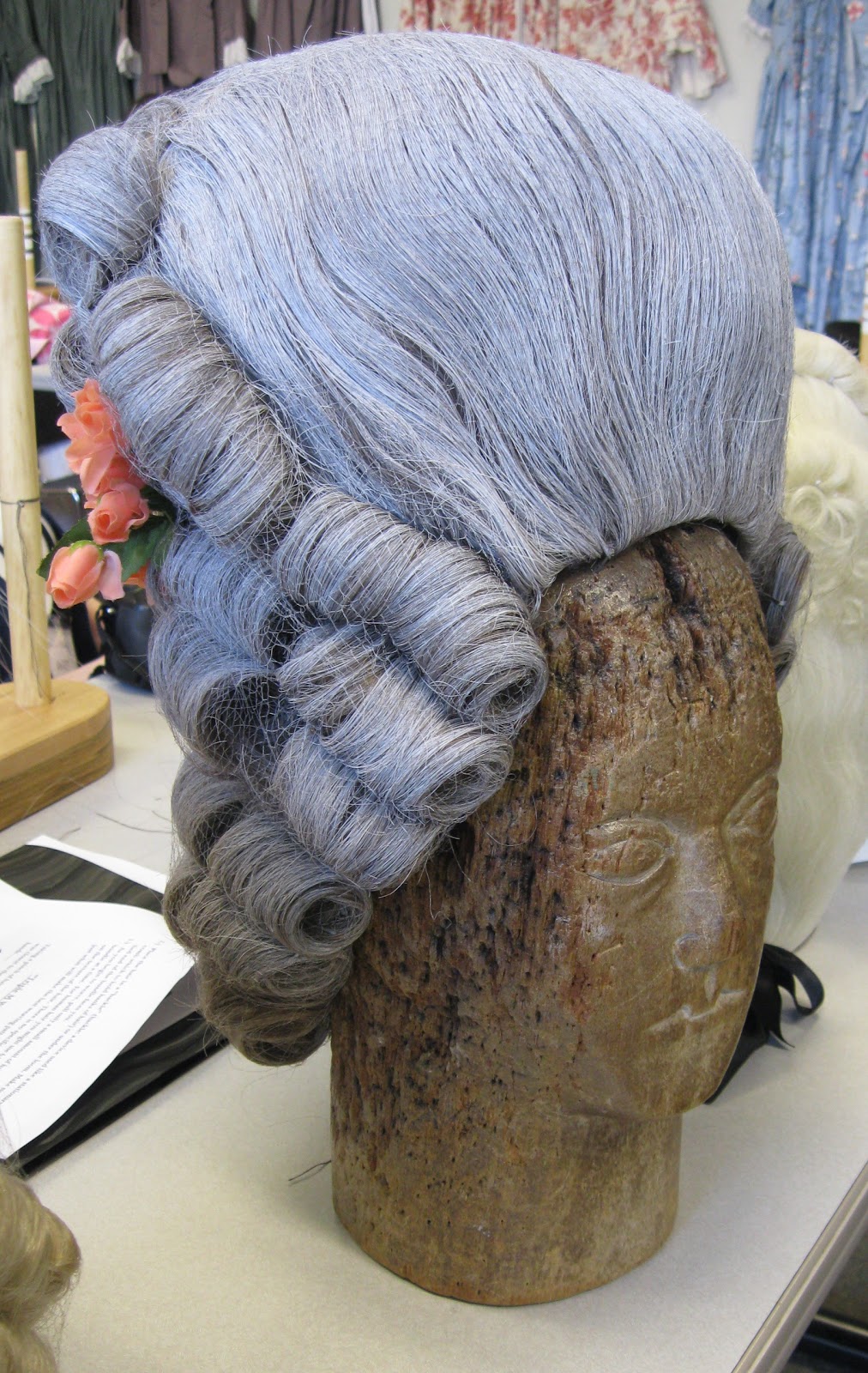
No other accessory is so completely associated with the 18th c. than a wig, and preferably one dusty with powder. Dr. Anne Bissonnette, assistant professor in material culture & curatorship, & curator, clothing & textiles collection, University of Alberta, explored all-important hair in Off with Their Wigs! Traditions and Revolutions in Hairstyles, 1748-1804.
Beginning with a survey of famous wig-wearers (the modern fashion for wigs began with Louis XIII of France, compensating for this own flagging locks in 1632), Dr. Bissonnette described how wig-wearing evolved from a court style to one that became almost universal in 18th c. England. Wigs were not only another symbol of rank, affluence, and fashion, but they could represent gravity as well in the wigs worn by doctors, barristers, and judges. While most wigs were in the natural colors of white, grey, blond, and brunette, later in the century there are references to wigs of lavender and rose – though Dr.Bissonnette cautioned that that could also be interpreted as the wig's perfumed scent instead of the color.
But perhaps the most intriguing suggestion raised by Dr. Bissonnette concerned the influence of ancient Rome on 18th c. hair and wig styles. While most historians point to the cropped styles of the French Revolution as the beginning of classical styles, Dr. Bissonnette believes that the trend began much earlier in the century, spurred by the rediscovery of Pompeii in 1748, and there is an undeniable similarity between the tall stiffened curls of 18th c. wigs, upper left, and the hair shown on Roman portrait busts, lower left.
Robin Kipps, supervisor, Pasteur & Galt Apothecary, CW, explored a different aspect of 18th c. style with A Prescription for Health and Fashion. Doctors and other health experts of the time not only linked clothing as the cause of bad health (one example was swaddling infants, which could lead to convulsions), but also used clothing to dispense medicine, with aromatic herbs quilted into nightcaps to cure headaches and powdered Peruvian bark stitched into quilted waistcoats to be worn to fight ague (malaria.)
Specialized clothing also carried underlying messages about health. A woman's riding habit, upper right, was fashionable and flattering, but it also advertised to the world that the wearer practiced the healthy and often-prescribed regimen of riding.
Like modern doctors in scrubs, Georgian physicians wore distinctive clothing for their profession. While a surgeon making his rounds always wore his wig, a surgeon preparing to operate, lower right, wore a blue linen apron buttoned to his waistcoat and blue sleeves tied on to protect his arms. The traditional blue might have been simply because the color masked blood stains more readily than white – but can it be only an unsettling coincidence that 18th c. butchers are often depicted in caricatures wearing shirts of the same blue?
Upper left: Reproduction 18th c. wig, Colonial Williamsburg.
Lower left: Portrait of a woman of the Flavian period. Marble, 80s-90s A.D. Rome, Capitoline Museums.
Upper right: Reproduction lady's riding habit, c. 1770, Colonial Williamsburg
Bottom left: Reproduction surgeon's dress, c. 1770, Colonial Williamsburg
More from Accessories: Head to Toe, a symposium hosted by Colonial Williamsburg, March 12-16, 2011.
No other accessory is so completely associated with the 18th c. than a wig, and preferably one dusty with powder. Dr. Anne Bissonnette, assistant professor in material culture & curatorship, & curator, clothing & textiles collection, University of Alberta, explored all-important hair in Off with Their Wigs! Traditions and Revolutions in Hairstyles, 1748-1804.
Beginning with a survey of famous wig-wearers (the modern fashion for wigs began with Louis XIII of France, compensating for this own flagging locks in 1632), Dr. Bissonnette described how wig-wearing evolved from a court style to one that became almost universal in 18th c. England. Wigs were not only another symbol of rank, affluence, and fashion, but they could represent gravity as well in the wigs worn by doctors, barristers, and judges. While most wigs were in the natural colors of white, grey, blond, and brunette, later in the century there are references to wigs of lavender and rose – though Dr.Bissonnette cautioned that that could also be interpreted as the wig's perfumed scent instead of the color.
But perhaps the most intriguing suggestion raised by Dr. Bissonnette concerned the influence of ancient Rome on 18th c. hair and wig styles. While most historians point to the cropped styles of the French Revolution as the beginning of classical styles, Dr. Bissonnette believes that the trend began much earlier in the century, spurred by the rediscovery of Pompeii in 1748, and there is an undeniable similarity between the tall stiffened curls of 18th c. wigs, upper left, and the hair shown on Roman portrait busts, lower left.
Robin Kipps, supervisor, Pasteur & Galt Apothecary, CW, explored a different aspect of 18th c. style with A Prescription for Health and Fashion. Doctors and other health experts of the time not only linked clothing as the cause of bad health (one example was swaddling infants, which could lead to convulsions), but also used clothing to dispense medicine, with aromatic herbs quilted into nightcaps to cure headaches and powdered Peruvian bark stitched into quilted waistcoats to be worn to fight ague (malaria.)
Specialized clothing also carried underlying messages about health. A woman's riding habit, upper right, was fashionable and flattering, but it also advertised to the world that the wearer practiced the healthy and often-prescribed regimen of riding.
Like modern doctors in scrubs, Georgian physicians wore distinctive clothing for their profession. While a surgeon making his rounds always wore his wig, a surgeon preparing to operate, lower right, wore a blue linen apron buttoned to his waistcoat and blue sleeves tied on to protect his arms. The traditional blue might have been simply because the color masked blood stains more readily than white – but can it be only an unsettling coincidence that 18th c. butchers are often depicted in caricatures wearing shirts of the same blue?
Upper left: Reproduction 18th c. wig, Colonial Williamsburg.
Lower left: Portrait of a woman of the Flavian period. Marble, 80s-90s A.D. Rome, Capitoline Museums.
Upper right: Reproduction lady's riding habit, c. 1770, Colonial Williamsburg
Bottom left: Reproduction surgeon's dress, c. 1770, Colonial Williamsburg
Monday, February 14, 2011
A Doctor's Report for January-February 1815
Loretta reports:
~~~
MEDICAL REPORT
AN account of the practice of a physician from the 15th of January to the 15th February, 1815.
Peripneumony, 3 ... Pleurisy, 2 ... Catarrh, 10 ... Sore-throat, 4 ... Fever, 3 ... Rheumatism, 8 ... Head-ach, 2 ... Palsy, 2 ... Mania, 1 ... Hysteria, 1 ... Asthenia, 6 ... Asthma, 2 ... Cough and dyspnœa, 18 ... Consumption, 5 ... Measles, 3 ... Small-pox, 1 ... Dyspepsia, 4 ... Diarrhœa, 5 ... Gastrodynia, 2 ... Jaundice, 1 ... Dropsy, 3 ... Palpitation, 1 ... Ischuria, l ... Leucorrhœa, 2 ... Menorrhœa, 3 ... Cutaneous affections, 5 ... Diseases of infants, 8.
Although during the recent mild weather pulmonic disease has abated, some severe cases have occurred. In a case of obstinate and long-continued head-ach, unconnected with disorder of the primæ viæ, cupping afforded great relief. This affection, however, often depends upon the state of the stomach, and is much influenced by the biliary secretion. By attending to the functions of the liver and stomach, and inducing a healthy action in these organs, the pain in the head frequently ceases. But it occasionally depends on too great a determination of blood to the head, or an impeded circulation, or an altered state of the brain; and is even sometimes much influenced by the greater or less density of the atmosphere. Of all these causes, the most difficult to remove is the altered condition of the brain itself, of which as an organic substance, notwithstanding the researches of anatomists and the discoveries of physiologists, we yet know very little. So intimate is the connection between the mind and the brain, that what affects the one influences the other ; there is constant action and reaction. Intense thinking will occasion head-ach, and a slight pressure on the brain, as is often witnessed in accidents, as well as an increased flow of blood to the head, will destroy the power of thinking, in fact annihilate every faculty of the mind . . . Were it possible to obtain more frequent dissections of the organ, with accurate histories of the cases, much more light would be thrown on the mental aberrations, as well as the disorders of the brain, which at present are involved in considerable obscurity.
~~~
Rudolph Ackermann, The Repository of arts, literature, commerce, manufactures, fashions and politics, 1815.
~~~
MEDICAL REPORT
AN account of the practice of a physician from the 15th of January to the 15th February, 1815.
Peripneumony, 3 ... Pleurisy, 2 ... Catarrh, 10 ... Sore-throat, 4 ... Fever, 3 ... Rheumatism, 8 ... Head-ach, 2 ... Palsy, 2 ... Mania, 1 ... Hysteria, 1 ... Asthenia, 6 ... Asthma, 2 ... Cough and dyspnœa, 18 ... Consumption, 5 ... Measles, 3 ... Small-pox, 1 ... Dyspepsia, 4 ... Diarrhœa, 5 ... Gastrodynia, 2 ... Jaundice, 1 ... Dropsy, 3 ... Palpitation, 1 ... Ischuria, l ... Leucorrhœa, 2 ... Menorrhœa, 3 ... Cutaneous affections, 5 ... Diseases of infants, 8.
Although during the recent mild weather pulmonic disease has abated, some severe cases have occurred. In a case of obstinate and long-continued head-ach, unconnected with disorder of the primæ viæ, cupping afforded great relief. This affection, however, often depends upon the state of the stomach, and is much influenced by the biliary secretion. By attending to the functions of the liver and stomach, and inducing a healthy action in these organs, the pain in the head frequently ceases. But it occasionally depends on too great a determination of blood to the head, or an impeded circulation, or an altered state of the brain; and is even sometimes much influenced by the greater or less density of the atmosphere. Of all these causes, the most difficult to remove is the altered condition of the brain itself, of which as an organic substance, notwithstanding the researches of anatomists and the discoveries of physiologists, we yet know very little. So intimate is the connection between the mind and the brain, that what affects the one influences the other ; there is constant action and reaction. Intense thinking will occasion head-ach, and a slight pressure on the brain, as is often witnessed in accidents, as well as an increased flow of blood to the head, will destroy the power of thinking, in fact annihilate every faculty of the mind . . . Were it possible to obtain more frequent dissections of the organ, with accurate histories of the cases, much more light would be thrown on the mental aberrations, as well as the disorders of the brain, which at present are involved in considerable obscurity.
~~~
Rudolph Ackermann, The Repository of arts, literature, commerce, manufactures, fashions and politics, 1815.
Sunday, February 13, 2011
Finding Conjugal Bliss in Dr. Graham's Celestial Bed:1781
Susan reporting:
Exploiting the love-lives of the rich and famous is hardly a new pursuit. From ancient times, charlatans have offered exotic, expensive potions to increase flagging libidos and unusual regimes designed to restore the magic to chilly marriages. One of the most infamous of these is Dr. James Graham (1745-1794), a self-proclaimed physician, self-promoter, and inventor (Wikipedia luridly categorizes him as a "sexologist") who captured the imagination of English society in the 1780s – and a good deal of their money besides.
Like all good quacks, Dr. Graham had a splendid gimmick, and his was the Temple of Hymen in Shomberg House in Pall Mall, a kind of overwrought clinic for his unusual treatments. His most profitable speciality was improving conjugal sex and fertility, and he found a clamoring audience among the upper classes whose survival depended on producing healthy heirs. Many of his customers were weakened by venereal disease and general dissipation, but that didn't stop Dr. Graham from making the same outlandish guarantees that often appear today in spam folders. His celebrity clientele included politicians John Wilkes and Charles James Fox, aristocrats such as the Duchess of Devonshire and the Duke of Richmond, and courtesans like Elizabeth Armistead and Mary Robinson.
While his treatments varied from elixirs to mud baths, the centerpiece of the Temple of Hymen was the Celestial Bed. This over-sized bed (it measured nine by twelve feet) could be tilted for an optimum angle, and was supported by glass rods that could permit the bed and its occupants to become so charged with static electricity that it gave off a greenish glow. Decorative automata, a pair of live turtle doves, and lush bouquets of fresh flowers were also features of the bed. Adding to the ambiance was a mattress stuffed with a special mixture of sweet-smelling herbs and hair from the tails of the most rampant English stallions, while a special celestial pipe organ played music calculated to inspire love-making. For the next three years, until Dr. Graham's extravagance landed him in prison for debt and bankruptcy, there were plenty of couples eager for the experience.
The price of a magical night in the Celestial Bed? An astonishingly steep fifty pounds. Did it work? Perhaps – though who wanted to admit that it didn't?
In honor of Valentine's Day, the Museum of London is recreating Dr. Graham's Celestial Bed as a special adults-only exhibition. For more information about this, as well as more detailed descriptions of Dr. Graham's claims, see here – though be forewarned that this post, like the exhibition, is probably best not read at work.
Above: The Celestial Bed, with the Rosy Goddess of Health reposing thereon, 1782
Exploiting the love-lives of the rich and famous is hardly a new pursuit. From ancient times, charlatans have offered exotic, expensive potions to increase flagging libidos and unusual regimes designed to restore the magic to chilly marriages. One of the most infamous of these is Dr. James Graham (1745-1794), a self-proclaimed physician, self-promoter, and inventor (Wikipedia luridly categorizes him as a "sexologist") who captured the imagination of English society in the 1780s – and a good deal of their money besides.
Like all good quacks, Dr. Graham had a splendid gimmick, and his was the Temple of Hymen in Shomberg House in Pall Mall, a kind of overwrought clinic for his unusual treatments. His most profitable speciality was improving conjugal sex and fertility, and he found a clamoring audience among the upper classes whose survival depended on producing healthy heirs. Many of his customers were weakened by venereal disease and general dissipation, but that didn't stop Dr. Graham from making the same outlandish guarantees that often appear today in spam folders. His celebrity clientele included politicians John Wilkes and Charles James Fox, aristocrats such as the Duchess of Devonshire and the Duke of Richmond, and courtesans like Elizabeth Armistead and Mary Robinson.
While his treatments varied from elixirs to mud baths, the centerpiece of the Temple of Hymen was the Celestial Bed. This over-sized bed (it measured nine by twelve feet) could be tilted for an optimum angle, and was supported by glass rods that could permit the bed and its occupants to become so charged with static electricity that it gave off a greenish glow. Decorative automata, a pair of live turtle doves, and lush bouquets of fresh flowers were also features of the bed. Adding to the ambiance was a mattress stuffed with a special mixture of sweet-smelling herbs and hair from the tails of the most rampant English stallions, while a special celestial pipe organ played music calculated to inspire love-making. For the next three years, until Dr. Graham's extravagance landed him in prison for debt and bankruptcy, there were plenty of couples eager for the experience.
The price of a magical night in the Celestial Bed? An astonishingly steep fifty pounds. Did it work? Perhaps – though who wanted to admit that it didn't?
In honor of Valentine's Day, the Museum of London is recreating Dr. Graham's Celestial Bed as a special adults-only exhibition. For more information about this, as well as more detailed descriptions of Dr. Graham's claims, see here – though be forewarned that this post, like the exhibition, is probably best not read at work.
Above: The Celestial Bed, with the Rosy Goddess of Health reposing thereon, 1782
Wednesday, January 26, 2011
Sore Throat? Try Hannah Woolley's Sirrop of Violets, 1675
Susan reporting:
Like many, many people in the northern hemisphere, I have a cold, which is probably why I've found the new exhibition at the Folger Shakespeare Library in Washington, DC so intriguing. Beyond Home Remedy: Women, Medicine, & Science is running now through May 14. While women of every rank have traditionally been the family medical caretakers, dispensing home-made remedies and folk wisdom, this exhibition shows their early recipe and housekeeping books instead as the precursors to modern medicine, and stresses the female contributions to the growth of scientific learning.
One of the books on display is The queen-like closet, or Rich cabinet
, above, by Hannah Woolley (1622-c.1675), published in 1675. Hannah came from a family where both her mother and her sisters were skilled in "physick and chirurgery," and her books on household management were among the first to be written by a woman for a female audience. Below is her recipe for syrup of violet, a popular remedy for soothing a sore throat. Yet this same simple syrup was also employed in experiments on color conducted by philosopher and chemist Robert Boyle (1627-1691). The Folger's site has a fascinating short video explaining these experiments, as well as how Hannah's concoctions, being made by a woman, would never merit the same attention as those of Boyle's, an educated gentleman and the son of an earl.
Meanwhile, if you, too, are suffering from a malady of the throat, here is Hannah's recipe transcribed – though good luck gathering fresh violets in January.
To make Sirrop of Violets
Pick your Violets very clean, and beat them well in a Mortar, then strain them, and to one pint of the juyce take one quarter of a pint of Spring-water; put it into the Mortar with the stamped Violets which you have strained, stamp them together a while, and strain the Water well from them, and mix them with your other juyce; then put it into a long Gally-pot, and to each pint of juyce put in one pound of double Refined Sugar; let it stand close covered for the space of twelve hours; then put in a little quantity of Juyce of Lemmon, that will make it look purely transparent; then set your Gally-pot into a Kettle of seething-water covered, till you find it to be thick enough; then set it by till it is cold, then put it up.Above: The queen-like closet, or Rich cabinet, by Hannah Woolley, London, 1675
Thanks to Michael Robinson for suggesting this exhibition to us.
Wednesday, December 1, 2010
Miracle remedies of 1807
Loretta reports:
The ladies' magazines include some interesting advertisements for "unmentionable" problems.
~~~
BELLS MONTHLY COMPENDIUM OF ADVERTISEMENTS FOR DECEMBER 1807
SIR HANS SLOANE'S RESTORATIVE AND RE-ANIMATING PILLS.
For those distressing Debilities which prevent, or render unhappy the Marriage State (but cannot, with a due regard to delicacy, be mentioned in a public Magazine), long experience has proved Sir Hans Sloane's Restorative and Re-animating Pills to be the most certain and sovereign remedy.
A Pamphlet, containing a more particular description of their virtues, and much useful information to the afflicted, may be had (price 1s.) at Mr. Perrin's, No. 23, Southampton-street, Covent-Garden, London; where they are sold wholesale and retail; and retail by all the principal Medicine Venders in London.—To persons in the country (inclosing payment and postage to Mr. Perrin, as above) they will be immediately forwarded, price 10s 6d.
SOLOMON'S GUIDE TO HEALTH.
Females are certainly liable to many Diseases that render their condition truly wretched and unequal, when compared with the other sex. If they enter the wedded state, even from that source of pleasure something bitter arises, and pregnancy brings with it a length of loathing, &c; if they remain single, they will scarcely avoid Labouring under some infirmity, because they are strangers to a mother's pangs.
Solomon's Guide to Health, price 3s. contains a complete Treatise on those Secret Infirmities of Nature, which delicacy often forbids to disclose, even to their nearest relatives: and a Treatise on Female Diseases, Nervous, Hypochondriac, and Consumptive Complaints.
Also, the Cordial Balm of Gilead, 10s 6d. is the best Medicine for Relaxations, Debility, Lassitude, Tremors, Sinking of the Spirits, and all those Nervous Affections which harrass and oppress the weak, sedentary, and delicate.
The family £33s.bottles contain four half-guinea ones, and are sold by Matthews and Leigh, No. 18, Strand, London.
From La Belle assemblée, Volume 3, 1807
The ladies' magazines include some interesting advertisements for "unmentionable" problems.
~~~
BELLS MONTHLY COMPENDIUM OF ADVERTISEMENTS FOR DECEMBER 1807
SIR HANS SLOANE'S RESTORATIVE AND RE-ANIMATING PILLS.
For those distressing Debilities which prevent, or render unhappy the Marriage State (but cannot, with a due regard to delicacy, be mentioned in a public Magazine), long experience has proved Sir Hans Sloane's Restorative and Re-animating Pills to be the most certain and sovereign remedy.
A Pamphlet, containing a more particular description of their virtues, and much useful information to the afflicted, may be had (price 1s.) at Mr. Perrin's, No. 23, Southampton-street, Covent-Garden, London; where they are sold wholesale and retail; and retail by all the principal Medicine Venders in London.—To persons in the country (inclosing payment and postage to Mr. Perrin, as above) they will be immediately forwarded, price 10s 6d.
SOLOMON'S GUIDE TO HEALTH.
Females are certainly liable to many Diseases that render their condition truly wretched and unequal, when compared with the other sex. If they enter the wedded state, even from that source of pleasure something bitter arises, and pregnancy brings with it a length of loathing, &c; if they remain single, they will scarcely avoid Labouring under some infirmity, because they are strangers to a mother's pangs.
Solomon's Guide to Health, price 3s. contains a complete Treatise on those Secret Infirmities of Nature, which delicacy often forbids to disclose, even to their nearest relatives: and a Treatise on Female Diseases, Nervous, Hypochondriac, and Consumptive Complaints.
Also, the Cordial Balm of Gilead, 10s 6d. is the best Medicine for Relaxations, Debility, Lassitude, Tremors, Sinking of the Spirits, and all those Nervous Affections which harrass and oppress the weak, sedentary, and delicate.
The family £33s.bottles contain four half-guinea ones, and are sold by Matthews and Leigh, No. 18, Strand, London.
From La Belle assemblée, Volume 3, 1807
Tuesday, November 16, 2010
Beautiful (and Potent!) Castor Beans
Susan reporting:
When we first came across these tall (over six feet), gaudy plants with their fantastic pods in one of the gardens in Colonial Williamsburg, we'd no idea what they were – though they did remind us of something contrived by Dr. Seuss. If we'd been an 18th c. housewife, however, we would have recognized them as once, and would likely have had one growing somewhere in our kitchen garden – much to the distress and dread of our children.
This is a castor bean plant, and the seeds that grow within the prickly pink capsules are the source of castor oil. While castor oil has a long history – ancient Egyptians burned it in their lamps – now the oil is primarily used as a lubricant and in hydraulic fluids, as well as in pharmaceutical applications and in manufactured goods ranging from soap to dyes.
The castor bean can be a dangerous plant as well. The seeds, stems, and leaves contain high levels of rincin, which is poisonous to humans and animals. In the strange way of nature, the oil derived from pressing the hulled seeds is not toxic, but considerable care must be taken while harvesting.
In the historical past that prized a good purge, castor oil was known for its ability to produce a swift result that one source describes as "exceptionally violent diarrhea." We agree that that sounds pretty hideous, but we suppose it was the historical version of a "cleanse" today.
We think we'd rather admire it from afar...
When we first came across these tall (over six feet), gaudy plants with their fantastic pods in one of the gardens in Colonial Williamsburg, we'd no idea what they were – though they did remind us of something contrived by Dr. Seuss. If we'd been an 18th c. housewife, however, we would have recognized them as once, and would likely have had one growing somewhere in our kitchen garden – much to the distress and dread of our children.
This is a castor bean plant, and the seeds that grow within the prickly pink capsules are the source of castor oil. While castor oil has a long history – ancient Egyptians burned it in their lamps – now the oil is primarily used as a lubricant and in hydraulic fluids, as well as in pharmaceutical applications and in manufactured goods ranging from soap to dyes.
The castor bean can be a dangerous plant as well. The seeds, stems, and leaves contain high levels of rincin, which is poisonous to humans and animals. In the strange way of nature, the oil derived from pressing the hulled seeds is not toxic, but considerable care must be taken while harvesting.
In the historical past that prized a good purge, castor oil was known for its ability to produce a swift result that one source describes as "exceptionally violent diarrhea." We agree that that sounds pretty hideous, but we suppose it was the historical version of a "cleanse" today.
We think we'd rather admire it from afar...
Monday, November 15, 2010
Cholera's first visit to Paris, 1832
Loretta reports:
Setting books in the 1830s has made me acutely conscious of the shadow cholera—currently raging through Haiti—cast across Europe in the 19th century.
It first reached Paris in the spring of 1832. The following numbers are the city's daily death toll for April.
Apr 1—79, 2—168, 3—212, 4—342, 5—351, 6—416, 7—582, 8—769, 9—861, 10—848, 11—769, 12—768, 13—816, 14—692, 15—567, 16—512
“Up to the last of these dates, there had died in Paris alone, upwards of 8,700 persons ; and before the end of the month the number was nearly doubled….
“In Paris, as in Hungary, the populace took up the idea that the disease was indicted on them by their water and wine being poisoned. Under this impression they perpetrated the most atrocious murders ; it required but the finger of any miscreant to point out an obnoxious individual. An old Jew, who carried a bottle of camphor as a preservative, was called a poisoner, while passing through the market place of the Innocents. The market-women and poissardes attacked him, and he fell dead beneath repeated stabs. At Vaugirard, a village close by Paris, two young men, being attacked by the mob on the same pretext, sought refuge in the house of the magistrate. They were forced out, and murdered in the street.
At Paris, however, less than any where else, did the cholera maintain its character of choosing its victims among the squalid, the needy, and the dissolute. The panic, that reigned throughout the capital, was enormously increased by the number of persons, in the higher ranks, on whom the malady laid hold. Peers of France, members of the Chamber of Deputies, of the courts of justice, and of the diplomatic body, swelled the triumph of the pestilence. On the 6th of April, it struck down the prime-minister himself; and although he recovered from the first shock, the hand of death had been laid upon him too heavily to be removed.”
—Excerpt from The Annual Register of 1832.
Setting books in the 1830s has made me acutely conscious of the shadow cholera—currently raging through Haiti—cast across Europe in the 19th century.
It first reached Paris in the spring of 1832. The following numbers are the city's daily death toll for April.
Apr 1—79, 2—168, 3—212, 4—342, 5—351, 6—416, 7—582, 8—769, 9—861, 10—848, 11—769, 12—768, 13—816, 14—692, 15—567, 16—512
“Up to the last of these dates, there had died in Paris alone, upwards of 8,700 persons ; and before the end of the month the number was nearly doubled….
“In Paris, as in Hungary, the populace took up the idea that the disease was indicted on them by their water and wine being poisoned. Under this impression they perpetrated the most atrocious murders ; it required but the finger of any miscreant to point out an obnoxious individual. An old Jew, who carried a bottle of camphor as a preservative, was called a poisoner, while passing through the market place of the Innocents. The market-women and poissardes attacked him, and he fell dead beneath repeated stabs. At Vaugirard, a village close by Paris, two young men, being attacked by the mob on the same pretext, sought refuge in the house of the magistrate. They were forced out, and murdered in the street.
At Paris, however, less than any where else, did the cholera maintain its character of choosing its victims among the squalid, the needy, and the dissolute. The panic, that reigned throughout the capital, was enormously increased by the number of persons, in the higher ranks, on whom the malady laid hold. Peers of France, members of the Chamber of Deputies, of the courts of justice, and of the diplomatic body, swelled the triumph of the pestilence. On the 6th of April, it struck down the prime-minister himself; and although he recovered from the first shock, the hand of death had been laid upon him too heavily to be removed.”—Excerpt from The Annual Register of 1832.
Thursday, October 21, 2010
Fanny Burney was heroic, too
Loretta reports:
Breast Cancer Awareness Month seems a fine time to bring Fanny Burney to center stage.
Anyone who’s had a mammogram knows it isn’t fun. We women make jokes of it, mainly in the gallows humor vein.
You can read some here. But it’s more fun than a mastectomy, and way more fun than the mastectomies our foremothers underwent.
Fanny Burney had a mastectomy in 1811, without anesthesia or antibiotics, because there weren't any.
Here’s a summary, based on Claire Harman’s Fanny Burney: A Biography:
Ms. Burney developed a large—about the size of a fist—painful lump in her breast. She was in her fifties and she was in Paris at the time (she'd married a Frenchman). She consulted Napoleon’s celebrated army-surgeon Dominique-Jean Larrey.” Among other things, Ms. Harman tells us, “In the medical culture of the day, exposure of a female patient’s body to examination was not insisted on, and it is highly likely, given Fanny’s temperament and her stated ‘dread & repugnance’ of medical intervention ‘from a thousand reasons besides the pain,’ that Larrey had not actually seen the breast until he was just about to cut it off.” We learn that none of the doctors involved examined the tumor until the day of operation, “and even then, they didn’t touch it.”
Today it’s believed that the tumor was benign. Her chances of survival with a malignant one of that size were about nil. The operation alone killed some women. She not only survived to tell the tale but lived another 29 years.
You can read her account of the ordeal here. Warning: This is not for the squeamish. Some
readers may find it more harrowing than Colonel Ponsonby’s experience on the battlefield.
Perhaps less harrowing (well, except for the illustration of the instruments) and definitely more inspiring is the post at The Duchess of Devonshire blog, Huzzah for Bosoms.
~~~
I know I’ve been heavy on the blood and guts this week, but that’s done…for a while…I promise. Next week we’ve got some more treats in store from Colonial Williamsburg.
Breast Cancer Awareness Month seems a fine time to bring Fanny Burney to center stage.
Anyone who’s had a mammogram knows it isn’t fun. We women make jokes of it, mainly in the gallows humor vein.
You can read some here. But it’s more fun than a mastectomy, and way more fun than the mastectomies our foremothers underwent.
Fanny Burney had a mastectomy in 1811, without anesthesia or antibiotics, because there weren't any.
Here’s a summary, based on Claire Harman’s Fanny Burney: A Biography:
Ms. Burney developed a large—about the size of a fist—painful lump in her breast. She was in her fifties and she was in Paris at the time (she'd married a Frenchman). She consulted Napoleon’s celebrated army-surgeon Dominique-Jean Larrey.” Among other things, Ms. Harman tells us, “In the medical culture of the day, exposure of a female patient’s body to examination was not insisted on, and it is highly likely, given Fanny’s temperament and her stated ‘dread & repugnance’ of medical intervention ‘from a thousand reasons besides the pain,’ that Larrey had not actually seen the breast until he was just about to cut it off.” We learn that none of the doctors involved examined the tumor until the day of operation, “and even then, they didn’t touch it.”
Today it’s believed that the tumor was benign. Her chances of survival with a malignant one of that size were about nil. The operation alone killed some women. She not only survived to tell the tale but lived another 29 years.
You can read her account of the ordeal here. Warning: This is not for the squeamish. Some
readers may find it more harrowing than Colonel Ponsonby’s experience on the battlefield.Perhaps less harrowing (well, except for the illustration of the instruments) and definitely more inspiring is the post at The Duchess of Devonshire blog, Huzzah for Bosoms.
~~~
I know I’ve been heavy on the blood and guts this week, but that’s done…for a while…I promise. Next week we’ve got some more treats in store from Colonial Williamsburg.
Monday, October 4, 2010
Now, About Those Georgian False Teeth....
Susan reports:
While the 18th c. lady in our recent Horrible Histories video displayed a pretty horrible set of teeth for comic effect, missing teeth were no joke to many Georgian ladies and gentlemen. Primitive dental care and diseases like smallpox, malaria, and syphilis combined with diets heavy on sugar, sugary tea, and alcohol and light on fresh fruits and vegetables made for less than glorious smiles. Poets might sing of teeth like pearls, but the reality was likely much less attractive.
Probably the most famous sufferer of dental woes was first American president George Washington (1732-1799), who began losing his teeth while only twenty-two. Historical legend reports that he compensated by wearing clacking false teeth made of wood. But Washington was an affluent gentleman, and he could afford the best replacements then on the market. A pair of dentures that he ordered in 1798 (shown left) are an intricate construction of gold wire springs and teeth carved of hippopotamus ivory. These were the work of Dr. John Greenwood (1760-1819), a New York-based dentist who earned Washington's custom, and his gratitude, too. Though the dentures look dreadfully uncomfortable to modern eyes, they were apparently a great improvement over what Washington had been wearing.
The letters between the dentist and his presidential patient survive today (here they are on-line), and the advice that Greenwood offers regarding the care of the false teeth sounds surprisingly modern:
"The sett [of false teeth] that you sent me from Philadelphia which when I received was very black, occasioned either by your soaking them in port wine [then considered a common way to disinfect false teeth], or by your drinking it. Port wine being sower [sour], takes off all the polish, and [as an] Acid has a tendency to soften every kind of teeth and bone....Therefore it is very pernicious to the teeth. I advise you to either take them out after dinner and put them in clean water and put in another sett, or clean them with a brush and some chalk scraped fine, it will absorbe the acids which collects from the mouth and preserve them longer."
No word remains as to whether Washington took this advice or not. Still, it does add an interesting layer to the custom of gentlemen retiring from the ladies to drink their port in masculine peace, with the men not only unbuttoning a waistcoat button or two after a large meal, but also removing their teeth.
For more about Dr. Greenwood – a colorful 18th c. American in his own right – check out another of our fav blogs, Boston 1776, and here for more about his role as Washington's dentist.
While the 18th c. lady in our recent Horrible Histories video displayed a pretty horrible set of teeth for comic effect, missing teeth were no joke to many Georgian ladies and gentlemen. Primitive dental care and diseases like smallpox, malaria, and syphilis combined with diets heavy on sugar, sugary tea, and alcohol and light on fresh fruits and vegetables made for less than glorious smiles. Poets might sing of teeth like pearls, but the reality was likely much less attractive.
Probably the most famous sufferer of dental woes was first American president George Washington (1732-1799), who began losing his teeth while only twenty-two. Historical legend reports that he compensated by wearing clacking false teeth made of wood. But Washington was an affluent gentleman, and he could afford the best replacements then on the market. A pair of dentures that he ordered in 1798 (shown left) are an intricate construction of gold wire springs and teeth carved of hippopotamus ivory. These were the work of Dr. John Greenwood (1760-1819), a New York-based dentist who earned Washington's custom, and his gratitude, too. Though the dentures look dreadfully uncomfortable to modern eyes, they were apparently a great improvement over what Washington had been wearing.
The letters between the dentist and his presidential patient survive today (here they are on-line), and the advice that Greenwood offers regarding the care of the false teeth sounds surprisingly modern:
"The sett [of false teeth] that you sent me from Philadelphia which when I received was very black, occasioned either by your soaking them in port wine [then considered a common way to disinfect false teeth], or by your drinking it. Port wine being sower [sour], takes off all the polish, and [as an] Acid has a tendency to soften every kind of teeth and bone....Therefore it is very pernicious to the teeth. I advise you to either take them out after dinner and put them in clean water and put in another sett, or clean them with a brush and some chalk scraped fine, it will absorbe the acids which collects from the mouth and preserve them longer."
No word remains as to whether Washington took this advice or not. Still, it does add an interesting layer to the custom of gentlemen retiring from the ladies to drink their port in masculine peace, with the men not only unbuttoning a waistcoat button or two after a large meal, but also removing their teeth.
For more about Dr. Greenwood – a colorful 18th c. American in his own right – check out another of our fav blogs, Boston 1776, and here for more about his role as Washington's dentist.
Monday, September 27, 2010
Mrs. Bennet's Nerves, causes thereof
Loretta reports:
Curious about Mrs. Bennet’s* delicate nerves, and what exactly that meant in Jane Austen’s time, I found some surprisingly modern viewpoints in this book, published in 1808: A view of the nervous temperament: being a practical inquiry into the increasing prevalence, prevention, and treatment of those diseases commonly called nervous, bilious, stomach & liver complaints, by Thomas Trotter.
~~~
Nature has endued the female constitution with greater delicacy and sensibility than the male, as destined for a different occupation in life. But fashionable manners have shamefully mistaken the purposes of nature; and the modern system of education, for the fair sex, has been to refine on this tenderness of frame, and to induce a debility of body, from the cradle upwards, so as to make feeble woman rather a subject for medical disquisition, than the healthful companion of our cares…That it should be rude for an innocent young girl to run about with her brother, to partake of his sports, and to exercise herself with equal freedom, is a maxim only worthy of some insipid gossip, who has the emolument of the family physician and apothecary solely in view. A man of fortune and wealth, when he builds a stable or a dog-kennel for his horses or hounds, takes care that these companions of his field-sports shall be duly preserved sound in wind and limb, by frequent exercise out of doors, when he does not hunt.— But in no part of his premises do you see a gymnasium for his children…But we indulge our boys to yoke their go-carts, and to ride on long rods, while little miss must have her more delicate limbs trampt by sitting the whole day dressing a doll. Ancient custom has been pleaded in favour of these amusements for boys, as we read in Horace : but it is no where recorded, that the infancy of Portia, Arria, and Agrippina was spent in fitting clothes for a joint-baby…
Curious about Mrs. Bennet’s* delicate nerves, and what exactly that meant in Jane Austen’s time, I found some surprisingly modern viewpoints in this book, published in 1808: A view of the nervous temperament: being a practical inquiry into the increasing prevalence, prevention, and treatment of those diseases commonly called nervous, bilious, stomach & liver complaints, by Thomas Trotter.
~~~
Nature has endued the female constitution with greater delicacy and sensibility than the male, as destined for a different occupation in life. But fashionable manners have shamefully mistaken the purposes of nature; and the modern system of education, for the fair sex, has been to refine on this tenderness of frame, and to induce a debility of body, from the cradle upwards, so as to make feeble woman rather a subject for medical disquisition, than the healthful companion of our cares…That it should be rude for an innocent young girl to run about with her brother, to partake of his sports, and to exercise herself with equal freedom, is a maxim only worthy of some insipid gossip, who has the emolument of the family physician and apothecary solely in view. A man of fortune and wealth, when he builds a stable or a dog-kennel for his horses or hounds, takes care that these companions of his field-sports shall be duly preserved sound in wind and limb, by frequent exercise out of doors, when he does not hunt.— But in no part of his premises do you see a gymnasium for his children…But we indulge our boys to yoke their go-carts, and to ride on long rods, while little miss must have her more delicate limbs trampt by sitting the whole day dressing a doll. Ancient custom has been pleaded in favour of these amusements for boys, as we read in Horace : but it is no where recorded, that the infancy of Portia, Arria, and Agrippina was spent in fitting clothes for a joint-baby…
Sunday, March 21, 2010
Doctor, doctor
Loretta reports:
It's not 1810 and we're not miserable objects, most of us, but I wonder whether there's anyone out there who doesn't recognize this doctor-patient scenario.
Journal of a tour and residence in Great Britain: during the years 1810 and 1811 by Louis Simond.
Illustration above left is an 1820 view of Guy's Hospital. Below right is Middlesex Hospital from Ackermann's Microcosm of London (1808). You can see a larger, sharper image at Motco. More about the Microcosm here.
It's not 1810 and we're not miserable objects, most of us, but I wonder whether there's anyone out there who doesn't recognize this doctor-patient scenario.
I have been carried to one of the hospitals of this great town, supported by voluntary contributions. I shall relate what I saw. The physician, seated at a table in a large hall on the ground-floor, with a register before him, ordered the door to be opened; a crowd of miserable objects, women, pushed in, and ranged themselves along the wall; he looked in his book, and called them to him successively. Such a one! The poor wretch, leaving her wall, crawled to the table. " How is your catarrh ?" " Please your honour, no offence I hope, it is the asthma. I have no rest night nor day, and "—" Ah, so it is an asthma! It is somebody else who has the catarrh. Well, you have been ordered to take, &c." —" Yes, Sir, but I grow worse and worse, and—" —" That is nothing, you must go on with it,"—" But, Sir, indeed I cannot."—" Enough, enough, good woman, I cannot listen to you any more ; many patients to get through this morning,—never do to hear them talk,—go, and take your draught, &c."—The catarrh woman made way for a long train of victims of consumption, cases of fever, dropsy, scrofula, and some disorders peculiar to women, detailed, without any ceremony, before young students…
… There is, however, more indifference than ignorance here; for in no part of the world is the art of medicine carried farther than in London ; and, without being at all qualified to judge, the mere circumstance of this art and those who practice it being so much more respected here than in France, is sufficient to convince me of their superiority. In France, surgery is honoured, while medicine is slighted. Moliere has much to answer for this; and if Shakespeare had taken it into his head to laugh at physicians, there is no knowing how they would fare in England at this day.
Journal of a tour and residence in Great Britain: during the years 1810 and 1811 by Louis Simond.
Illustration above left is an 1820 view of Guy's Hospital. Below right is Middlesex Hospital from Ackermann's Microcosm of London (1808). You can see a larger, sharper image at Motco. More about the Microcosm here.
Subscribe to:
Posts (Atom)