Showing posts with label caricature. Show all posts

Monday, April 16, 2012

Who's Wearing the Ducal Breeches in 1775?

Isabella/Susan* reporting:

Satirical cartoons of the late 18th-early 19th c are seldom subtle (like these examples here and here), which makes this pair all the more interesting. Published in 1775 by Matthew Darly, the prints are not labeled with the subject's names, and modern historians are reluctant to give them a definite identity. Still, 18th c viewers would have instantly known who they represent, and it's an easy guess for us, too: Jane Gordon, Duchess of Gordon, and her husband, Alexander Gordon, 4th Duke of Gordon.

Jane Gordon (1748-1812) was one of the most discussed ladies of her generation. Georgian ladies were supposed to be decorative; Jane was a celebrated beauty, but she was also clever, savvy, out-spoken, and witty. Not only did she handle her husband's business affairs, but as a confidant of William Pitt the Younger, she was actively involved in politics as a noted Tory hostess. Many accused her of having far more influence than was suitable for a woman. Her personality and pro-Bonaparte sympathies eventually led to the end of her marriage and her social position with it.

In the drawing, above, called The Breeches in the Fiera Maschereta (Italian for "fine masquerade"), a woman with a duchess's plumes has hidden herself entirely in an enormous pair of men's breeches.  (If you're having trouble visualizing the front of the breeches, see this photo of an 18th c style pair.) Twentieth century wives with strong personalities were often described as "wearing the pants in the family," which could also sum up this drawing. But in a time when no woman wore breeches (or pants), there's a sharper edge to the humor. By meddling in men's affairs, the duchess is an unnatural woman - and one who strives to assume a male identity by assuming the ultimate male garment as a masquerade.

The companion drawing, right. is no more flattering to His Grace. Alexander Gordon (1743-1827) was an  energetic Scottish nobleman, popular with his tenants, but his marriage to Jane was widely regarded as a bitter, tumultuous disaster. Despite having a sizable family, the two eventually lived separate lives. Those who disliked his duchess and disapproved of the influence she maintained faulted the duke for not making her act in a more traditional wifely manner (though it was doubtful any man could have made Jane obey.)

In The Petticoat, at the Fieri Maschareta, a man is shown "masquerading" in a voluminous woman's petticoat, his gloved hand protruding from the pocket slits and the waist strings tied around his neck.  On his head is a ducal coronet, and the face that peeks out has an exaggerated version of the duke's profile. Garbed like this, he is not simply hiding behind his wife's skirts, but overwhelmed and emasculated as well - which is likely the way his overbearing wife's behavior was viewed.  Despite this caricature, however, the duke was behaving in an entirely male, ducal way. While his duchess ruled London society, he remained at Gordon Castle with his mistress nearby, siring four illegitimate children with her.

Above: The Breeches in the Fiera Maschereta & The Petticoat, at the Fieri Maschareta, published by Matthew Darly, London, 1775. The British Museum.  Many thanks to our blogly friend Heather Carroll for reminding us of this print!


*Why two names? The explanation is here.

Monday, April 9, 2012

Strange English Dining Customs & Furniture

Loretta reports:
~~~
There are some customs here not quite consistent with that scrupulous delicacy on which the English pique themselves.  . . . Drinking much and long leads to unavoidable consequences. Will it be credited, that, in a corner of the very dining room, there is a certain convenient piece of furniture, to be used by any body who wants it. The operation is performed very deliberately and undisguisedly, as a matter of course, and occasions no interruption of the conversation. I once took the liberty to ask why this convenient article was not placed out of the room, in some adjoining closet; and was answered, that, in former times, when good fellowship was more strictly enforced than in these degenerate days, it had been found that men of weak heads or stomachs took advantage of the opportunity to make their escape shamefully, before they were quite drunk; and that it was to guard against such an enormity that this nice expedient had been invented. I have seen the article in question regularly provided in houses where there were no men, that is, no master of the house ; the mistress, therefore, must be understood to have given the necessary orders to her servants,—a supposition rather alarming for the delicacy of an English lady.
Louis Simond, Journal of a Tour and Residence in Great Britain, During the Years 1810 and 1811, Volume 1 (1817 edition).

Seventeen years later, Prince Pückler-Muskau writes to his beloved Lucie about “one strange custom . . . a relic of barbarism which is extremely repugnant to our notions of propriety.
“This struck me especially today when an old admiral who, clad in his dress uniform, probably on account of Lord Melville’s presence, made use of this facility for a good ten minutes, during which period we felt as if we were listening to the last drops from a roof gutter after a long past thunderstorm.”

Illustration:  James Gillray, A Voluptuary under the horrors of digestion, 1792. Library of Congress Prints and Photographs Division Washington, D.C. 20540 USA

Thursday, March 29, 2012

Friday Video: Buster Keaton in the ring

Loretta reports:

I've incorporated early 19th C gentlemen's fondness for fisticuffs in several of my books.  For an idea of what boxing was really like back then, take a look at Georgian Boxing at Horrible Histories.


Fortunately for the squeamish, we don't have actual Regency era fisticuffs recorded on film—but here's Buster Keaton, my favorite silent film actor and comic genius, demonstrating his brilliance in the ring.


Cruikshank illustration from Pierce Egan's Life in London, 1821

Monday, March 26, 2012

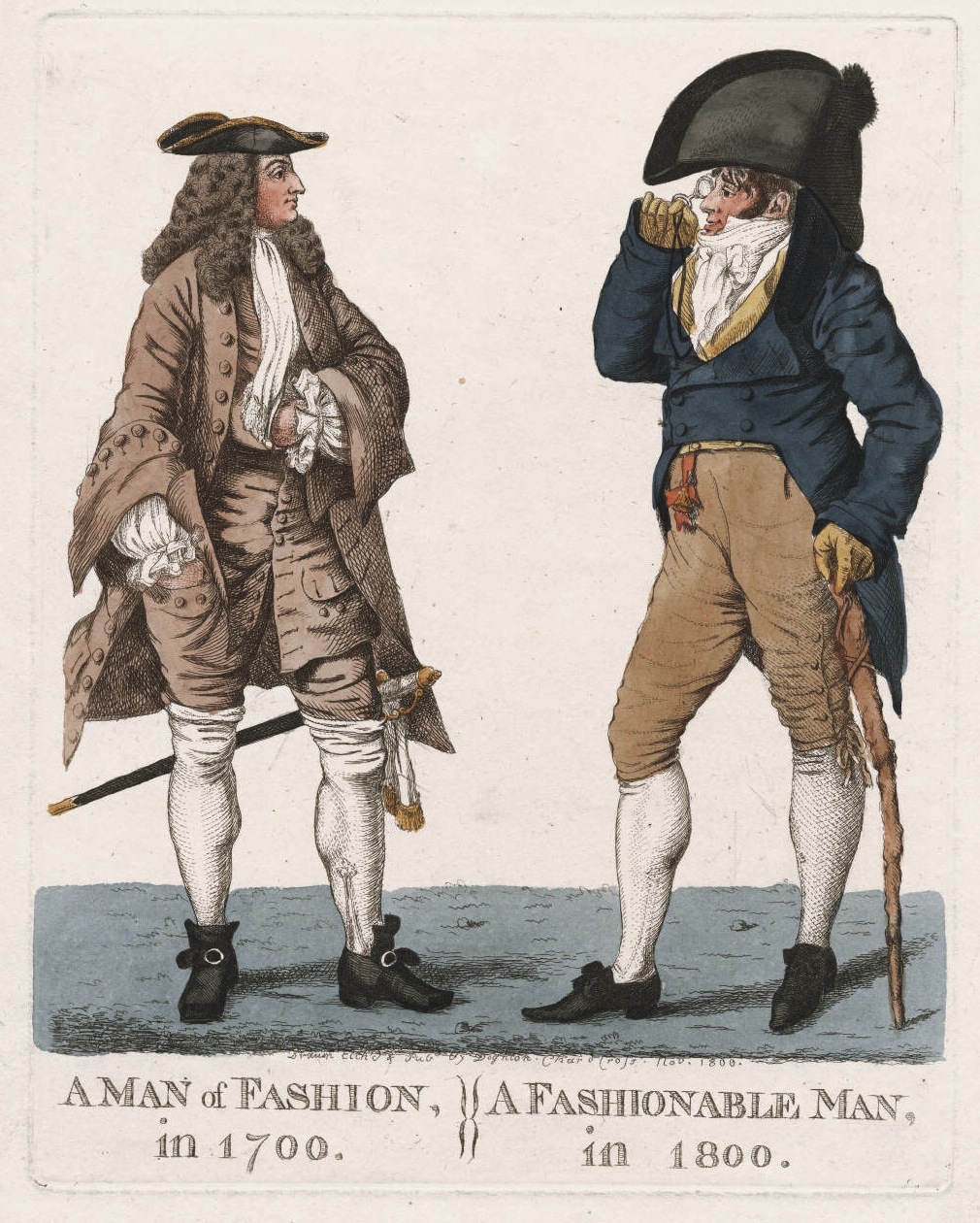
More Fashions for the Gentleman: 1700 vs. 1800

Susan reporting:

Loretta's post yesterday about poufy pants set me to thinking of other masculine fashion foolishness. Modern men are often let off the hook regarding fashions, as if they're somehow above that particular frivolity - or, others would argue, far beneath it. But in the past men had no qualms about playing the peacock and following fashion, even to its most extreme.

This print, left, is one of my favorites. (Click on the image to enlarge.) A century separates these two stylish English gentleman, a hundred years of evolving styles. Yet unlike most caricatures of male fashion (like our old friends Son Tom and the Young Macaroni), the attire of these two gentlemen isn't really exaggerated for their times. Judging by portraits of their respective contemporaries, both of these men could have walked down a London street without anyone turning to gawk – except perhaps at their handsomeness.

In addition to their clothes, I also like the men's different affectations. The difference between clothes and fashion often lies in the accessories, and what the wearer chooses to reveal of himself along with his taste. The earlier gentleman displays his studied nonchalance by tucking one hand in his open waistcoat and the other in his pocket. His wig is a virile mane, his stockings are purposefully slouchy, and he wears his sword – always ready to defend his honor  – hung impractically low (reminding me of how low certain rock stars will likewise sling their guitars.)

The later gentleman has traded a sword for a romantically rustic walking stick. Instead of the earlier nonchalance, this fellow is scrupulously tailored, his stockings and breeches snug-fitting and his neck cloth tied just so. At his waist are dangling seals with antique cameos, demonstrating his (possible) knowledge of antiquity. He wears his own hair instead of a wig, though the over sized cocked hat cancels that out. With his quizzing glass at the ready, he's prepared to examine the world instead of challenging it with a sword.

One more thing to note: in light of last week's post about wearing the proper socks, both gentlemen are wearing stockings with clocks – the decorative designs running vertically over their ankles.

Left: A man of fashion in 1700: A fashionable man in 1800, drawn, etched & published by Dighton, Charg. Cross, London, 1800. Copyright Lewis Walpole Library, Yale University.

Sunday, March 25, 2012

Men in poufy trousers

Metropolitan Museum of Art
Loretta reports:

Susan recently shared with me this image, whose description at the Met Museum site had me scratching my head.  I knew I’d seen this wasp-waist-&-full trousers-look earlier than the 1830s.  In fact, I had in mind an 1816 caricature—by Cruikshank, I think—of a dandy dressing.  His valet is helping him tighten his stays, and he’s wearing the full trousers.  Unable to put my hands on that caricature, I offer a group of 1818 fashion victims, with directions to the full-trouser wearers.

The Cruikshanks love making fun of this style, as in this excerpt from a poem in The Universal Songster, 1825:
 
Some folks, in the street, by the Lord, make me stare,
So comical droll is the dress that they wear;
For the gentlemen's waist is a top of their back,
And their large cossack trousers that fit like a sack.


Later, comparing to women's shortened skirts and huge hats, the poem continues:
 
Cruikshank
But, on the contrary, our very smart beaux,
Wear large cossack trousers quite down to their toes;
And a little brimmed hat, that wo’n’t cover their face,
Oh! Lunnun, this Lunnun’s a wonderful place!

Clearly it wasn’t the fashion, but a style that persisted alongside sleeker looks, according to the author of The whole art of dress,1830

But still the fashions, as may be remarked, are various, tight-kneed and full being worn almost indiscriminately. . .Nothing can more improve the look and fit of trousers than double straps; these, with very full cossack trowsers, are more indispensably requisite when the legs are particularly crooked or ill-formed.
The look never seems to die.  Decades ago I wore men’s vintage pleated wool trousers (with cuffs).  Susan thought the look was right for DeBarge.  I thought of M.C. Hammer.
Note straps

Photo info:
Date: ca. 1833; Culture: British; Medium: silk; Dimensions: Length at CB: 38 1/2 in. (97.8 cm); Credit Line: Catharine Breyer Van Bomel Foundation Fund, 1981'; Accession Number: 1981.210.4; www.metmuseum.org.
   
Cruikshank caricature courtesy  Courtesy Library of Congress Prints and Photographs Division Washington, D.C. 20540 USA

B&W illustration comes from a German collection whose record I've lost.

Tuesday, March 20, 2012

The 'Progress of a Woman of Pleasure', 1796


Susan reporting:

Just like Fanny Hill (1748) is erotica pretending to be a cautionary tale by a fallen woman, this print of the Progress of a Woman of Pleasure (1796) is less a moral warning then an excuse to display the protagonist's voluptuous attractions, and her remarkably extensive wardrobe, too. Even near death in the last image, she still hasn't exactly wasted away. (She's also one more example of the robust female ideal of beauty of the late 18th c.) There's none of the graphic illness and physical decay that appear in William Hogarth's earlier Harlot's Progress (1732), nor any of the next generation's guilt and remorse that would drive fallen women in Victorian art to hurl themselves off bridges. Instead this woman reminds me of the little cartoon "playmates" that decorated the pages of vintage Playboy magazines: a stylish, pneumatic male fantasy of a good-time party girl.

If there's an adolescent obsession with bared breasts in the Progress, it could be because the artist was only nineteen. Richard Newton (1777-1798) was the boy-prodigy of the great Georgian caricaturists, publishing his first satirical drawing at age 14 for London publisher William Holland. Just like his subject, Newton's own career was sadly meteoric; he was dead of 'prison fever' (Typhoid) at 21.

While you can (and should) click on the image above to enlarge it, the hand-written captions aren't easy to read. But because they're meant to be satirically amusing, I've transcribed them below, plus added a few explanations.

• Your first step for preferment will be to a great Lady in King's Place.*
• I see you now waiting in full dress for an introduction to a fine Gentleman with a world of money!
• You are now in high keeping and you accompany your Adonis to the Masquerade in the character of a Bacchante.
• Not being used to Champagne and not possessing the sweetest temper in the world in liquor, you give your Keeper a sample of it in flinging a glass of wine in his face!
• You are now turned off, and your only consolation is that your Hair Dresser promised to marry you.
• He loves you to distraction but he thought you'd have an annuity of 200 a year! I heard you roar out - "You dirty rascal I could get the smartest Linen Draper's Man in London with that money!"
• You now move to Marybone** and exhibit yourself in the Promenade in Oxford Street.
• Having met with a Crown customer, you tell him to go treat his Wife and Brats at Bagnigge Wells – you expected Five Guineas at least from him!
• You take a bumper of Brandy to comfort you after the disappointment and you drink 'bad luck all scaly fellows!'
• You now dance away at the Hop in Queen Ann Street East, and captivate all the men with your airs and graces!
• You wind up the evening with a Boxing match and a Warrant and Two Black Eyes salute you in the Morning.
• You are now over head and ears in debt in Marybone Parish and I see you shifting or removing your little wardrobe to Covent Garden***.
• You are glad of a Half Crown customer now, in a Prentice Boy who has just robbed his Master's Till.
• You are now the Mistress of a Player, who principally lives by Gambling; you ride out with him, cut a dash, and run him in debt; and to give him a sample of your spirit before you part you exercise a Horsewhip on his shoulders!
• You are now in a Spunging House****, heart sick at disappointment from all your Friends, and you stupify yourself with Gin.
• Having in a few years been the Mistress of Two Highwaymen, a Qui Tam Attorney*****, and two Shopmen who were Transported, I know see you at your last shift pawning your silver Thimble for a groat to purchase a Breakfast.
• Your Sun is now setting very fast, and I see you're the Servant of a woman who was formerly your Servant, you live on Board Wages, which seldom affords you more than a Bunch of Raddishes and a Pint of Porter for your Dinner.
• You take sick in the service of this female monster and she turns you out of doors fearing your Funeral expenses should fall upon her.

* King's-Place was the location of an infamous, high-class brothel run by the notorious madam Charlotte Hayes.
** Marybone (Mary-le-bone) was an area of London bordered by Oxford Street, and known for pleasure gardens, prostitutes, bear-bating, & prizefights.
***Covent Garden was the center of lower-class prostitution in 18th c London.
****A Sponging House was a place of temporary confinement for chronic debtors.
*****A Qui Tam attorney specialized in disreputable qui tam cases
******Board wages were wages paid, usually to servants, in the form of board (food) & lodging, generally of poor quality.
Above: Progress of a Woman of Pleasure by Richard Newton, 1796, hand-colored etching printed by William Holland, London.

Thursday, March 15, 2012

Friday Video: A Portrait of the Regency

William Elmes, Triumph of Love and Folly, 1812
Loretta reports:

Usually on Friday, we offer short video clips.  This one, recommended to me by one of our readers, is definitely not short—and it’s only the beginning of a fine series.

But Lucy Worsley, who’s entertained us before, does a marvelous job of bringing history to life, and—perhaps more important for Nerdy History People—she goes behind the scenes, talks to experts, and even dresses up like a Regency dandy (with the aid of Ian Kelly, the author of one of my favorite biographies, Beau Brummell:  The Ultimate Man of Style).

This is Part One of a three-part BBC series: Elegance and Decadence - The Age of the Regency.


Illustration courtesy Library of Congress Prints and Photographs Division Washington, D.C. 20540 USA.  Please click on caption to view the LOC page.

 Readers who receive our blog via email might see only a black rectangle or a square where the video ought to be.  To watch the video, please click on this link to the  Two Nerdy History Girls blog.

Sunday, March 11, 2012

The world of crime & criminals—Rowlandson & Weegee

Loretta reports:

We Nerdy History girls do a lot of compare and contrast between Then and Now, in fashion especially, but also in terms of human behavior.  While in New York City on Saturday,  I went to the International Center of Photography, to see, among other things, Murder is My Business, an exhibition of photographs by the famous mid-20th C tabloid photographer Weegee, one of my personal favorites.  As I walked through the exhibition, oddly enough, I found myself comparing and contrasting these stark black & white photos to the work of one of the great illustrators of the Regency era, Thomas Rowlandson.
Weegee, At an East Side Murder, 1943. © Weegee/International Center of Photography.
Now, let’s be clear here.  We’re not going to find Weegee’s blood and guts tabloid sensationalism in early 19th century art.  But what struck me, once I got past the starkly lit murder victims and pools of blood, were the spectators.  In some photos, we see people reacting to the crime or accident—tearful, horrified, fainting, laughing, smirking, blasĆ©—every shade of emotion.  Looking at a photo of bystanders at a murder scene, it’s startling to see people shrugging it off, or glancing at a corpse over their newspapers, or even grinning at the camera.

Yet I saw as well a direct connection to one of the early 19th century’s chroniclers of London life, Rowlandson—and in particular, his many illustrations dealing with criminal courts and executions.  When executions were done publicly, they attracted mobs of spectators, and in Rowlandson’s works, we see some of the same range of emotions as in the Weegee photographs.  An example is An Execution at Newgate, 1803.    

Thomas Rowlandson, Dr. Syntax Attends the Execution, 1820, courtesy Yale Center for British Art
Weegee captured life in the not-privileged part of New York.  Rowlandson took on life high and low, yet his crowd scenes, at Newgate and elsewhere, show the same variety of behaviors and emotions.  It seemed to me that only the outer trappings—the clothes & the environment, have changed, though not as much as you'd think—but the people?  Not at all, it seems to me.

More about the Weegee exhibition, here and here.

Tuesday, March 6, 2012

The Myth of the Regency Sylph

Susan reporting:

Seeing the fashions of 1810 featured in Loretta's blog yesterday reminded me of how fashion influences more than just silk and ribbons: it can also determine the stylish ideal of the body beneath those clothes.

Too often, however, the modern perception of what was hot in the late 18th-early 19th c is more a reflection of 21st ideals, especially as influenced by contemporary film versions of Jane Austen's novels. Our sylphs would not have been theirs. Keira Knightley, right, and Gwyneth Paltrow would have been pitied as sad, scrawny creatures, even perhaps consumptive. The ladies that everyone was ogling in a real Regency ballroom would have looked much more like this caricature of the notorious Emma, Lady Hamilton, left, by Thomas Rowlandson.

While later in her career, Emma would be cruelly depicted as blowsy and obese, here she is shown as an eminently desirable and fashionable beauty, with high breasts and well-rounded thighs and bottom. The same kind of lush figure tumbles through countless other drawings by Rowlandson and James Gillray; Google either artist, and you'll see these women over and over. It's easy to look at this body-type and imagine it wearing the clothes in the 1810 fashion plate, or in this one from 1808

The more flattering portrait of Emma, below, also shows exactly how robust a stylish lower half must have been. With fashion dictating a temporary respite from boned corseting, narrow waists lost their importance as an erogenous zone. Instead the interest  shifted to the lush, voluptuous curves below the waist, revealed by the drifting drapery of light silks and linens. For men who had been raised in an era when these mysterious body-parts had been hidden by hoops and heavily draped skirts, the sudden change must have been...exciting.

Where did this different kind of body ideal come from? Just as ancient Roman and Greek art and architecture was influencing nearly every aspect of the decorative arts in the late 18th-early 19th c, fashion, too, took a classical turn. High-waisted gowns and draping shawls were designed to emulate ancient fashions, embroidery patterns featured classical motifs, and looped and knotted hairstyles showed a classical influence as well.

But the undressed bodies of ancient nude statuary also set new standards of physical beauty. While Georgian aristocrats on their Grand Tours were busily checking out naked marble goddesses all across the Continent, one of the must-see statutes was the Aphrodite Kallipygos, right, on display in Naples. This much-admired statue is thought to be a 1st c BC Roman copy of an earlier Greek bronze, and her provocative pose must have left a definite impression of classical booty on countless young Englishmen.

The statue may also have influenced Lady Hamilton, living with her husband Sir William in Naples. For special guests to their villa, Emma performed her "Attitudes," a series of graceful poses inspired by classical art – the same "Attitudes" satirized by Rowlandson in the caricature at the top of this page. While Emma performed in a quasi-classical costume, not in the buff as Rowlandson shows her, there is a similarity between the pose – and the voluptuous figure.

Top left: Lady Hamilton's Attitudes by Thomas Rowlandson, 1790
Lower left: Detail, Emma, Lady Hamilton as Ariadne by Elisabeth Vigee-Lebrun, 1790
Lower right: Aphrodite Kallipygos, artist unknown, 1st c BC, National Archaeological Museum, Naples

Tuesday, February 28, 2012

Prowling London at Midnight

Loretta reports:

“Of all the bucks in this buckish age,” The English Spy declares, “your London buck is the only true fellow of spirit; with him life never begins too early, or finishes too late.”

This is a very short excerpt from four London gentlemen’s nightlong journey.  After hanging out with the racing fraternity, they’re working their way down to ever sleazier establishments.  The authorities busted the last one, and our boys had a narrow escape.  Nothing daunted, they continue their lark.
Illustration by Robert Cruikshank
~~~
There is something very romantic in prowling the streets of the metropolis at midnight, in quest of adventure; at least, so my companions insisted, and I had embarked too deeply in the night's debauch to moralize upon its consequences. . .

"There is yet, however, one more place worthy of notice," said Crony; "not for any amusement we shall derive from its frequenters, but, simply, that it is the most notorious place in London." Thither it was agreed we should adjourn; for Crony's description  . . . was quite sufficient to produce excitement in the young and ardent minds by which he was then surrounded. I shall not pollute this work by a repetition of the circumstances connected with this place, as detailed by old Crony, lest humanity should start back with horror and disgust at the bare mention, and charity endeavour to throw discredit on the true, but black recital. The specious pretence of selling shell-fish and oysters is a mere trap for the inexperienced, as every description of expensive wines, liqueurs, coffee, and costly suppers are in more general request, and the wanton extravagance exhibited within its vortex is enough to strike the uninitiated and the moralist with the most appalling sentiments of horror and dismay. Yet within this saloon (see plate) did we enter, at four o'clock in the morning, to view the depravity of human nature, and watch the operation of licentiousness upon the young and thoughtless.

A Newgate turnkey would, no doubt, recognize many old acquaintances; in the special hope of which, Bob Transit has faithfully delineated some of the most conspicuous characters, as they appeared on that occasion, lending their hearty assistance in the general scene of maddening uproar. It was past five o'clock in the morning ere we quitted this den of dreadful depravity, heartily tired out by the night's adventures, yet solacing ourselves with the reflection that we had seen much and suffered little either in respect to our purses or our persons.
The English Spy, Part 2, 1825

Monday, February 27, 2012

"Strong nerves, strong legs, strong language": Women on Bicycles, 1890

Susan reporting:

In the 1890s, more and more women began to ride bicycles, both for exercise, convenience, and independence. As can be imagined, this horrified a good many people, who saw women on wheels as a dangerous threat to families, morals, health, and, of course, the fair, delicate flower of womanhood.

We expect to see women cyclists defended by Susan B. Anthony (who famously wrote that bicycling "has done more to emancipate women than anything else in the world.") But the English novelist John Galsworthy (1867-1933)? The Nobel Prize-winning author of The Forsyte Saga evidently had his own strong feelings about women on bicycles – at least if we are to believe this passage from his novel, On Forsyte 'Change, taking place in 1890:

"Such historians as record the tides of social manners and morals, have neglected the bicycle. Yet would it be difficult to deny that this 'invention of the devil'...has been responsible for more movement in manners and morals than anything since Charles the Second. At its bone-shaking inception innocent, because...[it was] only dangerous to the lives and limbs of the male sex, it began to be a dissolvent of the most powerful type when accessible to the fair in its present form. Under its influence, wholly or in part, have wilted chaperons, long and narrow skirts, tight corsets, hair that would come down, black stockings, thick ankles, large hats, prudery and fear of the dark; under its influence, wholly or in part, have bloomed week-ends, strong nerves, strong legs, strong language, knickers, knowledge of make and shape, knowledge of woods and pastures, equality of sex, good digestion and professional occupation – in four words, the emancipation of woman."

Of course, this passage exists to fly in the florid face of Swithin 'Four-in-hand' Forsyte, an aged bachelor who promptly writes his very modern niece out of his will after he sees her astride a bicycle. While young Euphemia may have looked as entirely proper as the young lady, above, it's more likely the scandalized Swithin saw her more like the contemporary out-of-control women (with monocles!) in the satirical cartoon, right.

Above: Julia Blaess Klager, Michigan Bicyclist (detail), 1890s, photograph from Studio of Susan T. Cook, Ann Arbor, MI. See here for more information.
Below: Velocipeding, drawing from the cover of The Ferret, A Weekly Literary, Satirical, & Theatrical Journal of the Age, March 1870, London.

Tuesday, February 21, 2012

A Hat for Keeping Out the Sun, c. 1780

Susan reporting:

English ladies in the second half of the 18th c. loved their extravagant hats, especially when combined with extravagant hair (such as Daughter Ann wore in these prints here and here.) By 1780, the most fashionable hats had such low crowns as to have been little more than large brims – all the better to pile on the ribbons and plumes. As impractical as these hats may seem to us, they could act as a kind of sun-visor.

Here Amber Mendenhall, left, an intern in the Margaret Hunter shop in Colonial Williamsburg, wears one such fashionable hat. The hat is woven straw, covered with pleated white silk gauze and green striped silk ribbons. Worn low over the face, the wide brim would shade the face, and offer a certain amount of protection from the sun.
But this hat offers double protection: the underside of the brim is lined in black silk. (The photograph, right, shows the hat in progress, with the black lining pinned in place.) The black silk would have absorbed reflected sunlight, further protecting a lady's delicate complexion. While this might not have been much of an issue in England, the transplanted ladies living in the southern American colonies or on a Caribbean island would have definitely appreciated this added feature, and 18th c. advertisements show that such hats were in fact sold and worn in Jamaica.

Of course, every fashion could go to extremes – at least the way the 18th caricaturists show it. This lady, left, out for a stroll in Bath with her tiny dog under one arm and a book in her hand, seems ready to protect herself from the sun with a hat as large as a modern beach-umbrella. (Click on the image to enlarge.)

Lower left: A lodging house lady of Bath (detail), published by MDarly, London, 1777. Copyright Lewis Walpole Library, Yale University.
Photographs copyright Susan Holloway Scott

Wednesday, February 15, 2012

A Lady and Her Favorite, ahem, Footman, 1778

Susan reporting:

Since I'm currently working on a new series of novels set in England the 1760s (more about those soon, I promise), I've been looking at many of the wonderful prints of the Georgian era for inspiration. Prints were popular in 18th c England, a relatively inexpensive piece of art that could be pious, political, patriotic, educational, amusing, or outrageously bawdy.

Last month I shared the "My Daughter Ann" and "My Son Tom" prints, and the print, left, is another I especially enjoy. The Favourite Footman, or Miss well Mounted is based on a painting by John Collet (1725-1780), an artist known for his genre low-life subjects. (Click the image to enlarge.)

Collet's works are often filled with amorous ladies and gentlemen, sly servants, and double-entendres galore. The Favourite Footman is no exception. The title sets the scene: an expensively dressed young lady is out riding with her footman as an escort. Footmen were often chosen for their height and handsome faces, and having good-looking footmen in well-fitting livery was as important as having a matched team of spirited horses to draw one's carriage. This footman in his spurs is clearly a "Favourite," since he's been given the honor of helping the lady onto her horse, with the dog there to represent his loyalty.

But exactly how many other favors has the lady granted? She's certainly giving him an extensive view of her leg (remember, 18th c. women's clothing usually did not include under-drawers), and their pose and expressions imply intimacy.Their horses echo their interest, too, with her mare's tail suggestively raised for his stallion. And if anyone seeing the print missed all these broad hints about what  was going on, the second half of the title – Miss well Mounted – doesn't leave much doubt.

There's an extra level of subversive amusement in the print that 18th c viewers would have understood. The woman is in charge because of her wealth and social status, while he, as her servant, must obey her orders – a topsy-turvy arrangement that would have been seen in the 18th c as going against the "natural" order of males in control. But equally unnatural would be the notion of an upper-class woman, proud of her station, debasing herself with a servant of a much lower social class – even if, like this lady, she's ready to guide him with her tasseled whip.

Of course, there's always the possibility that the "miss" is the mistress of a wealthy man – which means she's giving away to her footman what her protector is paying for. Take note, Fanny Hill.

One more note about this print: Collet was an excellent chronicler of clothes. You might have recognized the lady's riding habit, recently recreated here, by Colonial Williamsburg tailor Mark Hutter.

Above: The Favourite Footman, or Miss well Mounted, after John Collet, 1778, published by Sayer & Bennett, London. The British Museum; © Trustees of the British Museum.

Wednesday, February 8, 2012

The Footman

Loretta reports:

I suspect the reality of the footman’s life lies somewhere between this satirical and rather cruel portrait and the job description in The Complete Servant—with the latter approaching nearer the truth.
~~~
... notwithstanding the stately gait with which he moves—staff in hand after his lady— notwithstanding his gold laced hat his gold or silver epaulets, his plush inexpressibles, his silk stockings, and well polished shoes . . . the cruel world regards him . . . with risible contempt . . .

 My lord duke of “below stairs” seems to be aware of this . . . When behind the coach, he rolls from side to side with consequential dignity, and keeps dancing upon his toes, to shew, as it were, the elasticity of his muscles.  In pedestrian attendance upon those whose bread he eats, he throws back his body even something beyond the perpendicular, and measures his steps with exactness and deliberation.  Every muscle of his face is composed, his eye never wanders, until his lady enters the confectioner's and haberdasher's shops; then “John” relaxes the rigidity of his attitude, leans forward upon his staff of office, and if happy enough to encounter his shadow in fine clothes, luxuriates with mincing accents, in anecdotes of the kitchen.  Perhaps some public house door stands invitingly open; if so he looks cautiously about him, and seeing the lady busy cheapening shawls, slips in for a moment, and returns with a complexion improved by the internal application of “blue ruin.”  The footman, however, is a person of some consequence; he does the honours of the hall, converses with noblemen, drinks with stable-keepers and dog-fanciers, and, if Swift was not much astray, prevents the physical decay of noble families.  There is always a smile upon his lip when in the presence of his superiors; and never refuses the doing of a kindness—when paid for it.

This, however, is only the description of the class; there are many individual exceptions; and there are few families who cannot boast of faithful servants.  In general, however, they furnish nothing but food for the writers of comedy, and subjects for the painter; Mr George Cruiksbank has left the lovers of pictoral accuracy nothing more to desire in this respect.
—George & Robert Cruikshank, The Gentleman's Pocket Magazine, 1827
~~~
More on footmen here & here.

Tuesday, January 24, 2012

Another Question of Georgian Taste: "What, Is This My Son Tom?" c 1774

Susan reporting:

Last week we looked at several satirical 18th c prints (here, here, and here) featuring Ann, the country girl transformed by London fashion into a creature her mother scarcely recognized.

But Ann was not alone in her transformation. Her brother Tom made the same trip to London, and he, too, has changed mightily. He's a true gentleman of fashion now, a fop, a macaroni, and the title of the print, left - What is this my Son Tom - says it all. (Click on the image to enlarge.)

The most prominent feature of his stylish self is his exaggerated wig that dwarfs his cocked hat. His wig is powdered white, his cheeks are rouged, and there's a huge bouquet of flowers pinned to his coat. He's covered with bows, embroidery, lace, and tassels, and his pale blue waistcoat and breeches are of a costly dotted fabric that may be an 18th c interpretation of an exotic leopard print. His phallic, low-slung sword is matched by a tasseled walking stick under his arm. He has a gold watch dangling at his waist and his shoes fasten with flower-shaped buckles glittering with paste (faux) stones.

By comparison, his incredulous father is the picture of a hale country fellow. His clothes are sturdy and unfashionably practical (his greatcoat looks very much like this one) and he wears his own straggly hair. He's even standing unfashionably, with his feet in boots and spurs wide-spread and a hand resting on his belly. Unable to believe what's become of his son, he prods at the towering wig with his whip.

True, this is another satire of fashionable Georgian dress, much like the Anne prints. But these, too, would have carried a secondary message that 18th c viewers would have understood. Tom's fashions would have been seen as French (Britain's near-constant enemy), and worse, effeminate. The older generation, represented by Tom's father, was convinced that modern young men were all soft and unmanly, a sure sign that the future of England was in terrible danger. Of course England didn't wither away because young men in the 1770s wore outlandish wigs and ruffles, any more than the country went to the dogs a generation later because Beau Brummel insisted on tall neck cloths and close-fitting trousers.

But Tom's father doesn't know that, and from the caption, he is WORRIED:

   Our wise Forefathers would express
   Ev'n Sensibility in Dress;
   The modern Race delight to Shew
   What Folly in Excess can do:
   The honest Farmer, come to Town,
   Can scarce believe his Son his own
   If thus the Taste continues Here,
   What will it be another Year?


Above: What is this my son Tom by S.H. Grimm, 1774, published by Robert Sayer & John Bennett, London. Copyright the Lewis Walpole Library, Yale University.

Friday, January 20, 2012

Update: One More Extravagant Daughter Anne, c 1775

Susan reporting:

After the two posts this week featuring the 18th c satirical prints of  daughter Ann horrifying her country mother with her London clothes, hairstyles, and morality (here and here, if you missed them), we heard from one of our readers, Cathy Kawalek, who had an Ann print of her own to share, left. The caption: Be not amaz'd Dear MOTHER...It is indeed your DAUGHTER ANNE.

Cathy bought the print at auction several years ago. The auction entry included this description: "One of a series of late 18th century 'droll' mezzotints which, like the Macaroni images, made fun of Georgian society. The image of a country woman meeting her daughter now in fashionable London dress was issued to exploit a popular joke. Mezzotints by Adams, Carington Bowles, John Bowles, and Sledge all appeared between 1773-75."

Once again there's the same theme - open-mouthed Mother is horrified by Anne's changed appearance - with a couple of differences. Anne's dress is even more extravagant, with sleeve flounces that fall clear to her knees and a richly embroidered gown. To look after her lap-dog, she's brought an attendant with her, an African or Indian servant, the perfect exotic accessory to a London lady of fashion. Mother is dressed in the same country-style apron, buckled shoes, and black hat that we've seen before, but with one surprising difference. She's also wearing a hooded pelisse, trimmed with ermine fur. Ermine is expensive, a fur used on noble and royal regalia as well as on fashionable clothes (like this.) So why is the country mother wearing it? Is the pelisse a costly, inappropriate gift from Anne to her mother? Or is there some now-forgotten joke connected to it that 18th c viewers would have understood immediately?

Above: "Be not amazed Dear Mother" after Samuel Grimm; printed for Carington Bowles, London, after 1774. From collection of Cathy Kawalek.
Many thanks to Cathy for sharing this with us!

Wednesday, January 18, 2012

Uh-oh - Daughter Ann's Really in Trouble Now! c 1775

Susan reporting:

When we last saw daughter Ann (in this 18th c print), she was proudly displaying her new finery and fantastically fashionable hair to her outraged mother. I wondered exactly how a country girl like Ann had come by such stylish and costly attire in London, and from her mother's expression, I suspected her mother did, too.

Soon after I posted that print and blog, I stumbled across this second print. Different artist, different publisher, but here again is our archetypal country girl Ann, still dressed to the nines (maybe even the tens) and clearly up to no good. From the shape of her breasts, it looks like she's even left off her stays, leaving her a true loose woman. This time her mother has followed her back to the city, and discovered Ann and a gentleman leaving a "house of accommodation," as Fanny Hill would have called it. Just in case there's any doubt, there's the inscription LOVE JOY over the door.

Her gallant is as fashionably/ridiculously dressed as she is, a prime macaroni with his own towering wig and tiny hat perched on the crest. Outraged Mom is again dressed in stodgy country clothes and thick soled-shoes, her hands raised in shock. She's here representing good old-fashioned morality, ready to haul her scandalous daughter back to the clean-living country where there are no men with tiny clown-hats and suggestively-jutting sword-hilts.

At least that's how it appears to us in the 21st c, with intervening Victorian morality muddling things further.

But the caption at the bottom of the print tells a different story:

   Is this my Daughter Ann
   The Matron thus Surpprised exclaims,
   And the deluded Fair One Blames,
   But had the Mother been as Charming,
   She had Thought the Mutual Sport no harm.
   This Moral's an undoubted Truth,
   Age envies Still the Joys of Youth.

In other words, an 18th c viewer would see the scene as a hilarious mockery of withered Mom and her envy of her beautiful daughter. Ann the Fair One isn't in trouble; it's Mom who's displaying her unbecoming jealousy. Maybe we should introduce her to the Old Beau.

I have to admit I'm stymied by the male figure in the background, and whatever it is he's holding. At first I thought it might be a looking-glass for vanity, but now I'm doubting it. The man wouldn't be in the print without a purpose. Any of you more learned folk than I have a guess what that might be?

Above: Is this my daughter Ann by J.H.Grim & James Watson printmaker, published in London by S. Sledge, 1774. Copyright the Lewis Walpole Library, Yale University.

Monday, January 16, 2012

The Height of Fashion (if not Virtue), c. 1771

Susan reporting:

Mothers and daughters warring over clothes is nothing new, with each generation pushing the limits of  fashion to the horror of the previous one. Young Anne, left, has returned home to the country after a sojourn in London.  She's dressed in the literal height of fashion, with towering hair and a richly trimmed gown displaying considerable bosom, and even a trendy little lapdog. Her modestly dressed mother is justifiably shocked, and cannot believe that this expensive creature is her daughter. (We've also seen country boys morph into macaronis in London, like the one here.)

Of course, with young country women in 18th c prints, there's always a more sinister (or at least cynical) explanation for wearing the latest London finery. In John Cleland's infamous 1748 novel Fanny Hill: Memoirs of a Woman of Pleasure, the orphaned and impoverished yet still innocent Fanny desires to go to London to "seek her fortune" ("a phrase, which, by the bye, has ruined more adventurers of both sexes, from the country, than ever it made, or advanced") only after admiring the stylish clothes of a visiting friend, Esther Davis:

"Nor can I remember, without laughing, the innocent admiration, not without a spice of envy, with which we poor girls, whose church-going cloaths did not rise about dowlass [coarse linen] shifts and snuff [thin wool] gowns, beheld Esther's scower'd sattin-gown, caps border'd with an inch of lace; taudry ribbons, and shoes belaced with silver! all of which we imagined grew in London....[I believed Esther when she explained  how] several maids out of the country  had made themselves and all their kin for ever, that by presarving their VARTUE, some had taken so with their masters, that they had married them, and kept them coaches, and lived vastly grand, and happy, and some, may-hap came to be Dutchesses: Luck was all, and why not I as well as another."

Once in London, Fanny soon learns that "VARTUE" was not rewarded nearly as profitably as sin, and receives her satin gown and carriage only after becoming the mistress to a wealthy lord.  Could that be what the horrified mother in this print suspects, too?

Above: Heyday! Is this my daughter Anne! by F.E.Adams, published 1779 by Robert Wilkinson, with an early version published 1771 by Carington Bowles. Copyright the Lewis Walpole Library, Yale University.

Sunday, January 1, 2012

A cure for rheumatism or gout


Gillray, The Gout
Loretta reports:

Welcome back, readers!  We hope you had fine holidays, and return to us refreshed, eager for another year of unbridled historical nerdiness.

We begin 2012 with a holiday that may be unknown to many of our readers, and an infallible cure for gout or rheumatism, courtesy Mr. William Hone’s Every-day Book, whose full title you'll find below.
~~~
The first Monday after new year's day is called Handsel Monday in some parts of Scotland, and is observed by merrymaking. In sir J. Sinclair's " Statistical Account," it is related of one William Hunter, a collier, that he was cured in the year 1758 of an inveterate rheumatism or gout, by drinking freely of new ale, full of barm or yeast. "The poor man had been confined to his bed for a year and a half, having almost entirely lost the use of his limbs. On the evening of Handsel Monday, as it is called, some of his neighbours came to make merry with him. Though he could not rise, yet he always took his share of the ale, as it passed round the company; and, in the end, became much intoxicated. The consequence was, that he had the use of his limbs the next morning, and was able to walk about. He lived more than twenty years after this, and never had the smallest return of his old complaint." This is a fact worth remembering, as connected with chronical complaints.
Rowlandson, Gouty Gourmands
The Every-day book and Table book:  or, Everlasting calendar of popular amusements, sports,
pastimes, ceremonies, manners, customs, and events, incident to each of the three hundred and sixty-five days, in past and present times; forming a complete history of the year, months, and seasons, and a perpetual key to the almanac including accounts of the weather, rules for health and conduct, remarkable and important anecdotes, facts, and notices, in chronology, antiquities, topography, biography, natural history, art, science, and general literature; derived from the most authentic sources, and valuable original communications, with poetical elucidations, for daily use and diversion, Volume 1, 1827 (the Google edition is 1838).

Illustrations:  
James Gillray, The Gout, 1799, courtesy Wikimedia Commons.
Thomas Rowlandson, Comforts of Bath, Gouty Gourmands at Dinner, 1798, courtesy Yale Center for British Art, Paul Mellon Collection.

Sunday, December 18, 2011

From the NHG Bookshelf: 'Hark! A Vagrant"

Susan reporting:

As you've probably gathered by now, Loretta and I are bona fide nerdy history girls, fortunate enough to be able to incorporate the swell history facts we discover in the fiction we write. I'd like to introduce you to another of our NHG sisterhood: cartoonist extraordinaire Kate Beaton.

If you've somehow managed to miss Kate's phenomenally popular on-line cartoon strip, Hark! A Vagrant, then this compilation, above leftby the same name of  is going to be a revelation. With a jittery line and an irreverent wit, Kate goes to the heart of history and literature (as well as the occasional foray into the popular-culture territory of Nancy Drew, Beyonce, and Wonder Woman) with hilarious results. If you still have room on your wish-list for Santa, then this book should be on it.

Kate's cartoons skewer not only big names like Napoleon and Shakespeare, but lesser-known historical folk like Maximilian I of Mexico and murderous grave-robbers Burke and Hare. Armed with a degree in history (she also studied anthropology, but as she herself notes, anthropology doesn't seem to turn up in her art), she gets the details right, and her cartoons are both funny and smart.

We're not alone in loving Kate Beaton, either. Hark! A Vagrant was recently named one of Time Magazine's top ten fiction books for 2011. When was the last time a cartoon book was honored like that?

The cartoons reproduced here are copyright Kate Beaton. No need for a FTC disclosure statement here; I'm such A Fan that I bought this book myself.