Thursday, September 30, 2010

Men Behaving Badly: the Hon. George Dalrymple & the Ladies of Paris: 1715

Susan reporting:

The Hon. George Dalrymple (d. 1745) was the third son of the first Earl of Stair. His older brother John (1673-1747) was much the more famous*, as an army officer, politician, and diplomat. Such is often the way with heirs to peerages; poor George seems to have been so thoroughly in his older brother's shadow that even his birthdate is now forgotten.

But in January, 1715, John journeyed to France as the newly appointed minister-plenipotentiary at Paris (aka the English ambassador), and George accompanied him. While John had a great many official duties to tend to, younger brother George had plenty of time to check out the female sights. Clearly he could have used the advice of a travel guide such as that would be written later in the century by Captain Thicknesse. George seems to have felt the usual English gentleman's disappointment (and the usual xenophobia) for the French ladies, as this excerpt from one of his letters proves:

"I have not been long enough here, to know, whether London or Paris is the most diverting town. The people here are more gay, the ladies less handsome, and much more painted, love gallantry more than pleasure, and coquetry more than solid love. This place is good for all those that have more vanity than real lust....This is the most diverting time to be at Paris because of the Fair Saint Germain. All the ladies go their every night at six o'clock and stay till ten. All that time they stroll about from the fair to the play and rope dancing and the rest of the things to be seen there and I am sure if the people there have a mind to be happy there is no difficulty to lose themselves. It is impossible to take more freedom, than that place allows of, and men and women stroll about without ceremony and everybody are taken up with their own projects so much that they do not mind what other people are doing. I am sure were such opportunities at London there would be many happy lovers. My brother being here makes it easy for me to get into good company though I am not as yet in love with anybody nor are the ladies handsome. I believe I shall only make love as I used to do to some chambermaid. I have already had some adventures of that kind."

Above: La Foire St. Germain, 1764.


* Another side-note about John Dalrymple: researching the background for this blog, I discovered that he was a F.O.M.C. – Friend of My Characters. In the army, he served as an aide-de-camp to John Churchill, Duke of Marlborough (the duke in Duchess), who became Dalrymple's patron and mentor. And when Dalrymple was eventually promoted to general and compelled to give up his regiment, he sold it to another Scotsman, David Colyear, Earl of Portmore, and the husband of Katherine Sedley, the heroine of The Countess and the King. It's a small world there in the Oxford Dictionary of National Biography....

Wednesday, September 29, 2010

The Fashionable Archer in 1831

Loretta reports:

If looking at history teaches us anything, it's to beware of making generalizations.  In my blog about Mrs. Bennet's nerves, author Thomas Trotter told us that girls were discouraged from getting exercise.  Yet that really isn't the complete picture.  Just as today there are extremes of fashionable dress, practiced by a minority, there were extremes of behavior.  We know that women rode and drove even in the Victorian era.  Bingley's sisters might laugh at Elizabeth for walking to Netherfield, but walking was deemed a healthful exercise, and many upper class women prided themselves on being able to walk long distances.

The following excerpt from an 1831 La Belle Assemblée indicates that many fashionable women knew their way around a bow and arrow.
~~~

GENERAL OBSERVATIONS
ON
FASHIONS AND DRESS.

THAT truly English pastime, archery, the delight of our forefathers and foremothers (no cavilling, good reader—we insist upon our right to coin a word now and then), is once more become fashionable ; and we hasten to present our fair readers with two dresses equally elegant and appropriate for that healthful and delightful amusement.

FASHIONS FOR SEPTEMBER, 1831.
EXPLANATION OF THE PRINTS OF THE FASHIONS.
 
ARCHERY DRESSES.
FIRST ARCHERY DRESS. A DRESS composed of changeable gros de Naples, green shot with white. The corsage, made nearly, but not quite, up to the throat, fastens in front by a row of gold buttons, which are continued at regular distances from the waist to the bottom of the skirt. The corsage sits close to the shape. The upper part of the sleeve forms a double bouffant, but much smaller than is usually worn. This is a matter of necessity, as the fair archer would otherwise cut it in pieces in drawing her bow. The remainder of the sleeve sits close to the arm. The brace, placed upon the right arm, is of primrose kid to correspond with the gloves. The belt fastens with a gold buckle ; on the right side, is a green worsted tassel used to wipe the arrow ; a green watered ribbon sustains the petite poche, which holds the arrows on the left side. A lace collar, of the pelerine shape, falls over the upper part of the bust. White gros des Indes hat, with a round and rather large brim, edged with a green rouleau, and turned up by a gold button and loop. A plume of white ostrich feathers is attached by a knot of green ribbon to the front of the crown. The feathers droop in different directions over the brim. The half-boots are of green reps* silk, tipped with black.

So as not to make a loooong blog, I'm putting the description of the Second Archery Dress at Loretta Chase...In Other Words.

*Reps: A French silk fabric having organzine warp the ribs are either warp or cross ribs. (From Louis Harmuth's Dictionary of Textiles (1915)

Tuesday, September 28, 2010

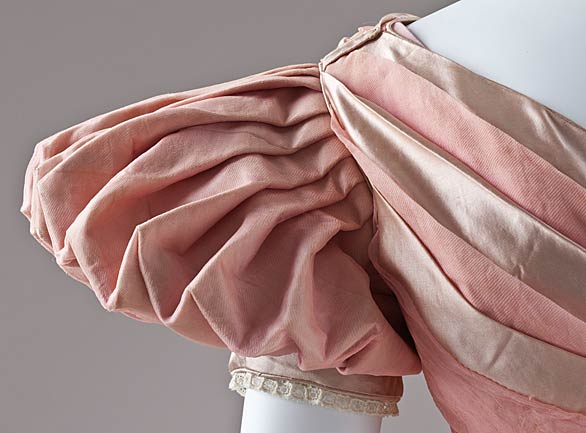
It's All in the Details: An Amazing Sleeve from 1830

Susan reports:

Loretta has shown us many examples of the exuberant gowns of the 1820s-30s (such as the detail, below, from this blog), and has even revealed exactly how those poufy sleeves were kept, well, so poufy. But often the fashion plates of the time are much like the editorial pages of modern high-fashion magazines, exaggerating to make their stylish point. It can be hard to imagine how real women would actually wish to wear some of these fashions, let alone maneuver through doorways.

Until, that is, a delicious dose of reality appears in an actual gown from the era. Above is a detail of a sleeve and bodice from an English dress, c. 1830. The sleeve is like some sort of wonderful, sculptural wing, and the intricate pleating and folding that gives it its shape is almost like origami. I know we have many seamstresses among our readers; can you imagine what the flat pattern for this sleeve must look like? There's an elegance here that the fashion plates can't begin to capture, and the fortunate lady who wore this blush-pink confection must have made an unforgettable entrance indeed.

This gown is included in the upcoming exhibition, Fashioning Fashion: European Dress in Detail, 1700-1915, at the Los Angeles County Museum of Art. You lucky folk in LA will be able to check it out from  October 2, 2010-March 6, 2011. For the rest of us, here's a gallery of photographs of some of the highlights of the show, courtesy of the Los Angeles Times, and here is the book that accompanies the show.

Above right: Evening Dress, detail of a fashion plate from The Atheneum, or Spirit of the English Magazine, July, 1831.

Monday, September 27, 2010

Mrs. Bennet's Nerves, causes thereof

Loretta reports:

Curious about Mrs. Bennet’s* delicate nerves, and what exactly that meant in Jane Austen’s time, I found some surprisingly modern viewpoints in this book, published in 1808:  A view of the nervous temperament: being a practical inquiry into the increasing prevalence, prevention, and treatment of those diseases commonly called nervous, bilious, stomach & liver complaints, by Thomas Trotter.
~~~
Nature has endued the female constitution with greater delicacy and sensibility than the male, as destined for a different occupation in life. But fashionable manners have shamefully mistaken the purposes of nature; and the modern system of education, for the fair sex, has been to refine on this tenderness of frame, and to induce a debility of body, from the cradle upwards, so as to make feeble woman rather a subject for medical disquisition, than the healthful companion of our cares…That it should be rude for an innocent young girl to run about with her brother, to partake of his sports, and to exercise herself with equal freedom, is a maxim only worthy of some insipid gossip, who has the emolument of the family physician and apothecary solely in view. A man of fortune and wealth, when he builds a stable or a dog-kennel for his horses or hounds, takes care that these companions of his field-sports shall be duly preserved sound in wind and limb, by frequent exercise out of doors, when he does not hunt.— But in no part of his premises do you see a gymnasium for his children…But we indulge our boys to yoke their go-carts, and to ride on long rods, while little miss must have her more delicate limbs trampt by sitting the whole day dressing a doll. Ancient custom has been pleaded in favour of these amusements for boys, as we read in Horace : but it is no where recorded, that the infancy of Portia, Arria, and Agrippina was spent in fitting clothes for a joint-baby…

Sunday, September 26, 2010

Avoiding the Sun with Lola Montez in 1858

Susan reporting:

Beauty advice from the past is often amusing to modern readers. The various concoctions that ladies in earlier eras used to "improve" the complexions range from charmingly benign (dew collected before dawn from the petals of roses) to unpleasantly bizarre (puppy urine) to appallingly lethal (white lead.) But every so often, there's advice that seems as if it could appear in any current fashion magazine for 21st c. beauties.

This excerpt comes from The Arts of Beauty; or Secrets of a Lady's Toilet, written in 1858 by the legendary actress, dancer, and courtesan Lola Montez (1820-1861). Lola's life is so colorful that she deserves to become an Intrepid Lady; what better way to describe an Irish girl born as Eliza Gilbert who creatively transformed herself into the exotic Lola Montez, Spanish dancer, lover of composer Franz Listz, and mistress to Prince Ludwig I of Bavaria (he made her Countess of Landesfeld), and whose journeys took her from the royal courts of Europe to Gold Rush San Francisco, and ever to the equally untamed wilds of Australia?

Today, however, we're offering only Lola's advice on "Habits that Destroy the Complexion." Substitute sun block for every mention of a bonnet and veil, and her cautions would please even the strictest modern dermatologist.

"There are many disorders of the skin which are induced by culpable ignorance, and which owe their origin entirely to circumstances connected with fashion or habit. The frequent and sudden changes in this country [she was writing in New York City] from heat to cold, by abruptly exciting or repressing the secretions of the skin, roughen its texture, injure its hue, and often deform it with unseemly eruptions....The habit ladies have of going into the open air without a bonnet, and often without a veil, is a ruinous one for the skin. Indeed, the present fashion of the ladies' bonnets, which only cover a few inches of the back of the head, is a great tax upon the beauty of the complexion. In this climate, especially, the head and face need protection from the atmosphere. Not only a woman's beauty, but her health requires that she should never step in the open air without a sufficient covering to her head. And, if she regards the beauty of her complexion, she must never go out into the hot sun without her veil...If she will not attend to these rules, she will be fortunate, saying nothing about her beauty, if her life does not pay the penalty of her thoughtlessness."

Above: Lola Montez, by Joseph Karl Stieler, 1847

Saturday, September 25, 2010

Imagining Social Networking Media in 1667 (Silly Historical Video)


This one is very short but sweet, and features both the subject of Johannes Vermeer's Girl with a Pearl Earring and our favorite Restoration diarist Samuel Pepys. Produced by a firm of British attorneys who specialize in protecting intellectual property, this quick film is one of a series highlighting the "potential of your imagination to change our world." That's a grand goal, but we liked this video because it made us laugh. Be sure to pause to read the other Tweets that Sam is receiving from other 17th century friends like John Evelyn. 

Here's a background blog about making the film, including the costuming and casting: clearly fellow history-nerds at work!

Thursday, September 23, 2010

Hare Townsend, ladies' man of the early 19th C

Loretta reports:

From The Rambler's magazine: or, Fashionable emporium of polite literature, Volume 2, 1823

ANECDOTES OF HARE T—N—D—MR.HARE T—N—D the M.P. is celebrated for his gallantry, and there are many anecdotes related of his amours, which shew him to be a very singular lover, and always a liberal one.

At a meeting of governors, to consider the funds of the Liverpool Lying-in Hospital, Mr. Hare sent a donation of £50; upon which, a governor remarked : " This is very liberal, for, if I mistake not, Mr. Hare is an annual subscriber." That I do not know, said the attendant accoucheur,* but I am certain he is an annual supplyer, and furnishes us with more practice than all the room besides.

A cockney who had long wished for a family, and had a wife more inclined to breed mischief than any thing else, removed her into Lancashire, not many miles from W—l—n, the seat of Mr. Hare T—n—d. There, to his great joy, she conceived and brought forth twins. The Reverend and witty Jack Pigot was in company with the citizen, when a friend remarked how extraordinary it was that the lady should bear children when she had been ten years married, without ever giving signs if such a happy event before. I think, said the husband, it is all owing to this country air.—No doubt, replied Jack Pigot, we are blessed with a fine Hare in this country that makes every woman breed like a rabbit. ——
…
Meeting once a little ragged urchin begging, he stopt to relieve him, and remarked: You are a fine boy, where is your mother — In the workhouse, please your worship. And who was your father, my little fellow !—I never had a father, said the child. Ah! muttered T—n—d as he walked away: 'Tis the first time I ever knew a child to be fatherless, and me in the parish.

A man and a woman were brought before him and some other magistrates. The woman was very great with child, and the bench suggested the man's commitment to gaol. Let me question them first, said Mr. Hare T—n—d. A pretty pair you are, said he, to get children without being married, how comes this ? Please your worship, replied the trembling sinners: We could'nt help it. Ah! observed he, and it were a sin to punish people for what they can't help; and as for once I did not help to get this child, I'll help you to get through the world with it. I have a fellow-feeling for you, as God knows I myself am often condemned for what I could not help.

*obstetrician