Tuesday, June 1, 2010

Labor-Saving Devices: The Geneva Fluter


Susan reporting:

As I've mentioned before, I'm a sucker for a good flea market. Last weekend I was prowling the goodies in Lancaster County, PA, and discovered this antique labor-saving device.

The rocker-like device is called a Geneva Fluter (it proudly says so right there, embossed on the top in raised letters), and many late 19th c. women would probably have recognized it. The fluter is a specialized kind of "sad iron", used to press the fluted ruffles on linen cuffs and collars and other trim. (Here's more about historical
ironing.)

Made from cast iron, the fluter would have been propped before the coals in the hearth to heat. The piece to be ironed would be moistened and laid over the grooved base. Then, with a potholder wrapped around the handle, the heated iron would be rocked over the cloth, and with a hiss of steam, the linen would be perfectly pressed with rows of narrow flutes or pleats.

The weight of the iron and the heat would do most of the work, and compared to pleating and pressing the narrow ruffles individually, this
truly must have been a labor-saving device. Still, there also must have been plenty of room for error and scorching, and the learning curve must have involved considerable trial and error, plus a burn or two.

Made by a foundry in Geneva, IL, that specialized in household goods, the popular hand fluters were manufactured from 1866-1920, and were exported around the world. Once only wealthy ladies with maids and laundresses could have such skillfully ironed linens. Now women of the rising middle class wished to be fashionable, too, and the Geneva fluter took its place in households across America.

My flea-market fluter came with a base that's of a later date (after 1890) that was made in Philadelphia, not Geneva, but the principle's the same. The top plate with the grooves opens, and iron slugs, heated before the hearth like the fluter, would be placed inside to heat the grooves above it. Here's the more elaborate fluter that originally accompanied the base.

Still, mismatched or not, I thought I'd try it out. Not with linen; I'm afraid of that "patina" of old rust and corrosion, nor do I have an open hearth. But I did run a strip of printer paper across the grooves, and viola! Perfectly fluted, ruffled printer paper.

Monday, May 31, 2010

Proper conduct between married persons

Loretta reports:

June being the wedding month, herewith follows some advice, circa 1833, regarding the proper conduct of married persons toward each other.

~~~~~
Of propriety of conduct in conjugal and domestic relations.

   If any thing can render politeness ridiculous, and even odious, it is the disposition of certain persons, who in society are moderate, amiable, and gracious, but in private show themselves morose, rough and ill-natured. This fault, much too common, is one of the greatest inconsistencies of the human mind. You use all your exertions to please the world which you only see cursorily, and in which you have only power to procure a few moments of pleasure, and you neglect to be agreeable to your husband or wife, from whom you expect the happiness of a whole life… Conjugal intimacy, it is true, dispenses with the etiquette established by politeness, but it does not dispense with attentions. In the presence of your wife or husband, you ought never to do those things which carry with them an idea of disgust, nor perform those duties of the toilet, which before any one but yourself offend decency and cleanliness.*

…If at any time the society of your husband or wife causes you ennui, you ought neither to say so, nor give any suspicion of the cause by abruptly changing the conversation…

   To entertain with a politeness particularly affectionate the friends of a person with whom you are connected by marriage; to respect inviolably the letters which she writes or receives; to avoid prying into the secrets which she conceals from you through delicacy; never to act contrary to her inclinations, unless they are injurious to herself, and even in this case not to oppose her, but to endeavor to check them with address and kindness; to beware of confiding to strangers or to domestics the little vexations which she causes you; to dread like poison marks of contempt, coldness, suspicion, or reproaches; to apologize promptly and in an affectionate manner if you have allowed yourself to run into any ill humor; to receive her counsels with attention, and benevolence, and to execute them as quickly as possible—these are the obligations of propriety and love, to which husbands possessed of gentleness bind themselves, by the sanctity of the vows which they have taken before God.

* As washing the feet, cutting the nails, &c.
~~~~~
Elisabeth Celnart, The Gentleman and Lady's Book of Politeness and Propriety of Deportment: Dedicated to the Youth of Both Sexes.  Translated from the French.

Saturday, May 29, 2010

Happy Birthday, Your Majesty!

Susan reports:

We here at the TNHG don't usually post on Saturdays, but this particular Saturday seemed too historically momentous to let pass by unnoticed.

May 29th is not only the 350th anniversary of the return of King Charles II (1630-1685) to London after his lengthy exile, but also his 380th birthday. I've written five historical novels in which Charles has featured prominently, and after those 600,000 or so words between us, I do feel I owe him the very best wishes for the day.

But I'll leave it to writer and diarist John Evelyn (1620-1707), who witnessed Charles's return to London, to describe the day and the jubilant welcome the king received:

"This day, His Majesty, Charles II, came to London, after a sad and long exile and calamitous suffering both of the King and the Church, being seventeen years. This was also his birthday, and with a triumph of above 20,000 horse and foot, brandishing their swords, and shouting with inexpressible joy; the ways strewn with flowers, the bells ringing, the streets hung with tapestry, fountains running with wine; the Mayor, Aldermen, and all the companies, in their liveries, chains of gold, and banners; Lords and Nobles, clad in cloth of silver, gold, and velvet; the windows and balconies, all set with ladies; trumpets, music, and myriads of people flocking, even so far as from Rochester, so as they were seven hours in passing the city, even from two in the afternoon till nine at night.

"I stood in the Strand and beheld it, and blessed God. And all this was done without one drop of blood shed, and by that very army which rebelled against him: but it was the Lord's doing, for such a restoration was never mentioned in any history, ancient or modern, since the return of the Jews from their Babylonish captivity; nor so joyful a day and so bright ever seen in this nation, this happening when to expect or effect it was past all human policy....The eagerness of men, women, and children, to see His Majesty, and kiss his hand, was so great, that he had scarce leisure to eat for some days, coming as they did from all parts of the nation; and the King being as willing to give them satisfaction, would have none kept out, but gave free access to all sorts of people."

From the Diary of John Evelyn, which has recently (finally!) become available for on-line reading here.

Thursday, May 27, 2010

Miseries of London

Loretta reports:

A lively Rowlandson illustration of a London street scene sent me to the material it illustrated, from one of my favorite books from the Regency era, James Beresford’s, The Miseries of Human Life.  Though written in 1807,  it proves that some aspects of human life haven't changed. The wait in a public office might, for instance, remind some of us of our last visit to the Registry of Motor Vehicles, while others might relate to the “hurry and ferment” of a recent visit to, say New York City.  And who hasn’t dropped money in a taxicab?

While on a short visit to London—the hurry and ferment— the crossing and jostling—the missing and marring—which incessantly happen among all your engagements, purposes, and promises, both of business and pleasure—at home and abroad—from morning till midnight;—obstacles equally perverse, unexpected, unaccountable, innumerable, and intolerable, springing up like mushrooms through every step of your progress. Then, (when you are at last leaving London,) on asking yourself the question whether any thing 'has been neglected, or forgotten, receiving for answer—"Almost every thing!"

In going out to dinner, (already too late,) your carriage delayed by a jam of coaches which choke up the whole street, and allow you at least an hour more than you require, to sharpen your wits for table talk.

In attempting to pay money in the street—emptying your purse into the kennel—the wind taking care of all the paper money.

The unintermitting fever into which you are thrown by being obliged to linger, the whole morning long, amongst a crew of " greasy rogues," in the outer room of a public office, from which you are called out the last—if, indeed, you are called out at all!

In taking out your money in a hackney-coach—dropping the greatest part of it (and all the gold) in the straw then, After grubbing and fumbling after it for an hour, finding nothing but the gaping crevices through which it must have escaped. 

Wednesday, May 26, 2010

The Pleasures of Peonies


Susan reporting:

If June belongs to roses, then surely May is the month for peonies. Peonies seem to me to be sumptuously old-fashioned flowers, which earns them a worthy place at the TNHG.

And as flowers go, peonies are very old flowers, more than old enough to qualify as historical. Peonies have been grown in China for thousands of years, though at first they were primarily revered not for their blooms, but for their medicinal purposes.

In traditional Chinese medicine, the bark of tree peonies and the roots of herbaceous varieties were used for cooling the blood and relieving both pain and infections. In medieval Europe, peonies became a favorite cure-all, recommended for relieving everything from gallstones, childbirth pain, epileptic seizure, and the ever-popular evil spirits.

It wasn't until the seventh century that peonies were used in ornamental gardens in China, and the flowers were soon so desired that they were placed under imperial protection. While the emperor's gardeners labored to foster more and
more extravagant blooms, his artists, too, were inspired by the flowers, and peonies can be found not only in Chinese screen paintings and woodblocks, but also woven into tapestries, embroidered in silk, and glazed onto porcelain.

By the eighth century, the Japanese had discovered ornamental peonies as well, but Western Europeans had to wait another thousand years. In 1789, legendary naturalist and botanist Sir Joseph Banks commissioned a tree peony to be brought to England by way of the British East India Company, and planted this first tree peony in Kew Gardens. The flowers remained difficult to obtain until the later 19th c., when English and American gardeners eagerly began developing varieties of their own.

With their air of the exotic, the lush flowers became favorites with Western artists in the 19th c., too, and appear in paintings by Renoir, Whistler, and Fantin-Latour as well as in Art Nouveau posters. What better captures the full-blown fin-de-siecle that a porcelain bowl overflowing with peonies?

I'm fortunate to live near the Winterthur Museum and Country Estate, and can enjoy their fabulous Peony Garden. Established nearly a century ago, the garden has hundreds of peonies of every variety and in colors that range from palest white to deep bronze. It's literally breath-taking, and well worth a visit if you're near Wilmington, DE in May. The photographs here were taken at Winterthur last year by my daughter; you know it's an impressive garden when its beauty captivates a teenager!

Top: Vase de Pivoines (Vase of Peonies) by Henri Fantin-Latour, 1881, Honolulu Academy of Art

Tuesday, May 25, 2010

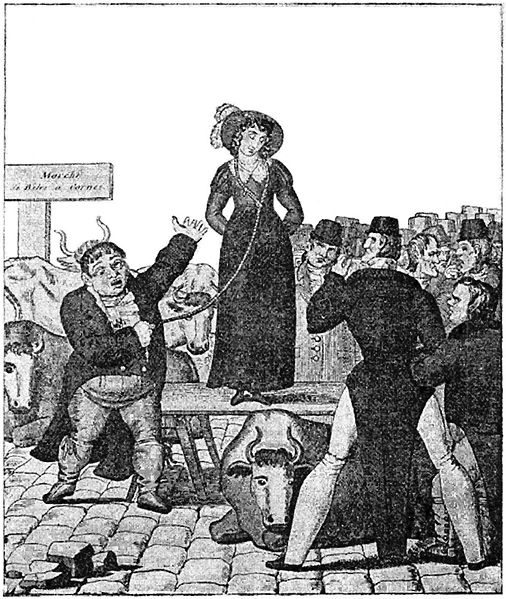
How to sell your wife

Loretta reports:

Divorce in England in the 19th century required an Act of Parliament.  Only the rich could afford it, and many couples remained legally bound in misery (usually the misery was on the wife’s part).  But for the lower orders, there was another method.

According to author John Ashton, “On this class, the marriage tie lay lightly, and a rough, and summary, method was sometimes used to dissolve it.”

The method was wife-selling, and Ashton goes on to give examples, gleaned from various periodicals.

Morning Herald, March 11, 1802: "On the 11th of last month, a person sold, at the market cross, in Chapel en le Frith, a wife, a child, and as much furniture as would set up a beggar, for eleven shillings!"

Morning Herald, April 16, 1802: "A Butcher sold his wife by auction the last market day at Hereford. The lot brought £1 4s. and a bowl of punch."

Annual Register, February 14, 1806: "A man named John Gorsthorpe exposed his wife for sale in the market, at Hull, about one o'clock ; but, owing to the crowd which such an extraordinary occurrence had gathered together, he was obliged to defer the sale, and take her away. About four- o'clock, however, he again brought her out, and she was sold for 20 guineas, and delivered, in a halter, to a person named Houseman, who had lodged with them four or five years."

Morning Post, October 10, 1807: "One of those disgraceful scenes, which have, of late, become too common, took place on Friday se'nnight at Knaresborough. Owing to some jealousy, or other family difference, a man brought his wife, equipped in the usual style, and sold her at the market cross for 6d. and a quid of tobacco !"

In the Doncaster Gazette of March 25, 1803, a sale is thus described : " A fellow sold his wife, as a cow, in Sheffield market-place a few days ago. The lady was put into the hands of a butcher, who held her by a halter fastened round her waist. 'What do you ask for your cow?' said a bystander. 'A guinea,' replied the husband. 'Done!' cried the other, and immediately led away his bargain. We understand that the purchaser and his 'cow' live very happily together."

John Ashton, The Dawn of the XIXth Century in England: a social sketch of the times.

Monday, May 24, 2010

Brave Faces in Old Photos


Susan reporting:

I love painted portraits, and seeing how a skilled artist can reveal the most subtle nuances of character and experience with only a brush and paint.

But a photographic portrait can be equally fascinating, and equally revealing, too, in a far different way. The old saying claims that a camera never lies (at least it didn't before Photoshop), and the earlier the camera, the more truth there is in the image. The harsh bright lights and unwavering poses required by 19th c. technology forced sitters to confront the camera with a frank immediacy that leaps over the decades.

I have no idea of the identity of the intense young gentleman, left. I scanned him from my great-great grandmother's album, where none of the pictures are identified. She knew who everyone was, and a good thing, too. As a very young woman before the Civil War, she left her family's farm back east and traveled across the plains and mountains to teach school in Marin County, CA. She would never return, nor had she expected to. Her album would have her last connection with old friends and family, and I've always wondered what this sharp-eyed gentleman meant to her. From his vertical hair (all the rage mid-century) and the stylishly loose fit of his coat, I'm guessing his picture dates from the 1850s, with his birthdate twenty-five years before that. But what's 180 years with a gaze like that?

The picture of the gentleman, right, is even older. In fact it's one of the earliest surviving American daguerreotypes, dating from 1839. Philadelphia chemist and silversmith Robert Cornelius (1809-1893) was fooling around with the new process, and took this picture of himself outside his shop. His hair is tousled, his pose hastily informal, and he's squinting both at the camera and the sun: but how amazing to be able to look into the eyes of someone born more than two hundred years ago!

I'm not the only one fascinated by old images like these. Recently several other blogs have featured evocative early photographs. Versailles & More has a remarkable video drawn from photographs of the veterans of Napoleon's armies. The Sartorialist invited readers to contribute vintage family shots, with amazing results from around the world.

Most heart-breaking of all, however, are the images of adolescent girls to be found at It's About Time. These girls were inmates in the Welsh prison of Newport Usk Gaol in the 1870s, and the pictures were taken of them upon their release. Their crimes were petty, mostly theft. Their sentences all included hard labor. The oldest girl is sixteen; the youngest eleven. At left is Selina Jenkins, age twelve, who served fourteen days hard labor for stealing a cloth jacket. Hanging around her neck is a tag with her prison number, and her expression seems exhausted and wary, yet resigned as well. Could there be a more achingly truthful portrait?