Tuesday, November 8, 2011

The privileges of being a peer

Loretta reports:

I think the following, taken with my recent blog on illegitimacy, offers some insight into the mindset of the upper classes.  So many rules didn’t apply to them—which helps explain the behavior we’ve blogged about here, here, here, and here, and elsewhere.
~~~
THE PRIVILEGES OF THE PEERS OF THE UNITED KINGDOM OF GREAT BRITAIN AND IRELAND.
The nobility of England enjoy many great privileges, the principal of which are as follows:
1. That they are free from all arrests for debts, as being the king's hereditary counsellors. Therefore a peer cannot be outlawed in any civil action, and no attachment lies against his person. This privilege extended also to their domestic servants, as well as to those of members of the lower house, till the year 1770 . . . For the same reason they are free from attending courts leet, or sheriffs turns; or, in cases of riot, from attending the posse comitatus.

2. In criminal causes they are only tried by their peers, who give their verdict, not upon oath, as other juries, but only upon their honour; and then a court is erected on purpose in the middle of Westminster Hall, at the king’s charge, which is pulled down when their trials are over.

3. To secure the honour of, and prevent the spreading of any scandal upon peers, or any great officer of the realm, by reports, there is an express law, called scandalum magnatum, by which any man convicted of making a scandalous report against a peer of the realm (though true) is condemned to an arbitrary fine, and to remain in custody till the same be paid.

4. Upon any great trial in a court of justice, a peer may come into the court, and sit there uncovered.
No peer can be covered in the royal presence without permission for that purpose, except the lord baron of Kinsale, of his majesty's kingdom of Ireland. See De Courcy, Baron Kinsale, in the Peerage of Ireland... In case of the poll-tax, the peers bear the greater share of the burden, they being taxed every one according to his degree.

— Debrett's Peerage of England, Scotland, and Ireland, 1820

Illustration:  House of Lords, from the Microcosm of London, 1808-1810

Monday, November 7, 2011

"A Map of the Open Country of a Woman's Heart", c. 1833

Susan reporting:

Recently I posted a pictorial map of Loveland that showed a charmingly optimistic and romantic view of love in America during World War II. 

This map from the 1830s, left, shows another heart-shaped fictitious land: A Map of the Open Country of Woman's Heart, Exhibiting its internal communications, and the facilities and dangers to Travellers therein. While it's a drollery, intended to be humorous, one wonders how many women were laughing.  Like so many 19th c. publications, this one claims to be the work of A Lady – but from the cynical tone of many of this map's landmarks, it's much more likely the work of A Man. (Click on the map to enlarge it and see the details.)

True, at the very center of this map lies the City and District of Love, with the modestly sized regions of Hope, Enthusiasm, Good Sense, and Prudence not far away. But the names of other towns and areas are much larger and less flattering, and include Coquetry, Love of Admiration, Selfishness,Vanity, and Jilting Corner. There are rivers called Drain the Purse, Willful Waste, and (horrors) Novel-Reading.

Clearly we're supposed to believe that the owner of this particular heart was shallow, greedy, and untrustworthy. Perhaps the most unsavory regions of the map are those marked Love of Display and Love of Dress, featuring the Pyramids of Fashion and the Satin Plains. Beneath the Promontory of Golden Fetters lies the Sea of Wealth, with Old Man's Darling Bay flowing into the suggestively shaped Jewelry Inlet. Oof!

Above: A Map of the Open Country of Woman's Heart, by A Lady, published by D.W. Kellog & Co., Hartford, CT, c. 1833-1842. From the collection of the American Antiquarian Society, gift of Charles H. Taylor

Sunday, November 6, 2011

Those shameless English aristocrats

Loretta reports:

An American waxes indignant about the English aristocracy’s shameless ways.
~~~
One of his subjects said that Charles II. was the father of many of his people in a literal sense.  He recruited the ranks of the nobility largely with his children and their mothers, and at least five English dukes to-day can trace their lineage to the monarch who left no legitimate descendant . . .

These offshoots of royalty claim all the distinction that their birth confers.  The daughter of a ducal house prides herself on her likeness to her great ancestor, Nell Gwynne, whose portrait hang in her drawing-room, so that all who come can compare.  You can pay her no higher compliment than to notice the resemblance which proves her royal origin . . .

Illegitimacy, however, in England is not confined to the descendants of royalty.  The nobility emulates the example set by a long line of sovereigns.  In the exalted circles of the aristocracy the bastards of peers go about bearing the family names, and daughters whose mothers are unrecognized marry into families as “good” as those on the paternal side.  There are even instances of sons born before the marriage of their parents, whose younger brothers inherit titles to which the elders would have succeeded, but for the neglect of their mothers to go to church in time: the legitimate and illegitimate children can claim precisely the same progenitors.  Some of these premature sons are to-day ministers at foreign courts, others have been masters of ceremonies in royal houses, while dukes and earls have been able to find places for the spawn of shame in the army, the Foreign Office, and even in that Church whose rites they had themselves neglected to observe.

God knows the unfortunates are not to blame; but to make their birth a distinction and an advantage is a greater enormity than the offence to which they owe their origin.
—Adam Badeau, Aristocracy in England, 1856

~~~
I'll let my readers decide whether American Victorians were more “Victorian” than their English counterparts . . .

Illustration:  Charles Beauclerk, 1st Duke of St. Albans, son of King Charles II & Nell Gwynne  

Saturday, November 5, 2011

Breakfast Links: Week of October 31, 2011

Served up fresh for you, our weekly offering of Breakfast Links: our favorite links to other blogs, web sites, pictures, and articles, all collected for you from around the Twitterverse.
• Halloween celebrations in Gilded Age America: http://bit.ly/dsDEV1
• Bonny Bobby Shafto http://post.ly/3lvWW
• Meet the 18th century book-keeper with a secret obsession: http://bit.ly/rOox9q
• Looking at how Sir Robert Shirley bridged cultures (and dressed accordingly) in the early 17th c:http://bit.ly/rzAvdg
• NYC's famous (& infamous) 1883 Chelsea Hotel, known for residents as well as architecture: http://bit.ly/uebAmj
• Here be dragons: British Library manuscripts app details how to be king http://bit.ly/vdPOLr
• Early 1920s swimsuits: Swimwear and the Sporting Life http://bit.ly/vnUFCT
• Westminster doors galore: The green one….no, the red one…you choose. I'm really not sure - http://bit.ly/cpsGaT
• Poster advertising the Royal Menagerie at the Tower of London, 1834: http://bit.ly/rE6CQD
• Ladies Accomplishments: A Late 18th-Century Paper Filigree Work Cabinet http://wp.me/pGJsu-1RC
• Early Music Online: 300 of earliest surviving printed, digitized from the British Library’s copies: http://bit.ly/nVnD9G
• Holding history in my hands: how an 1855 ambrotype can inform fashion history:http://bit.ly/rzR0lu
• William of Orange was born on 4 November 1650 in an atmosphere of funeral gloom. Why? http://bit.ly/tTeglp
• 'Caroline Crachami, the 19th c "Sicilian Fairy"' - http://wp.me/p14Gvd-sn
• Capturing your garden and your family: English Landscape & Portraitist Arthur Devis 1712-1787: http://bit.ly/uYXHdR 
• Mummification, ritual vessels, floral adornment: discover fascinating details of Tutankhamun's funeral:http://met.org/uHNWCq
• This breaks my heart: Goodbye at Pennsylvania Station, 1944 - http://bit.ly/sPK2yD
• Though they originated in China, it was in Europe that fireworks flourished: http://bit.ly/skqbuI
• Racine overwhelmed by full inbox. OMG! Twitter in 17th century? http://bit.ly/tHx4Zf 
• Marvelous profile of 18th c house in Whitechapel - AND it's for sale! ::sigh:: http://bit.ly/nRChw4 
Above: At Breakfast by Laurits Andersen Ring, 1898

Thursday, November 3, 2011

500 Years of Women's Portraits in Western Art - in Three Minutes


Susan reporting:

This video isn't new (it's nearly five years old, an eternity on the internet), but it's still quite marvelous, and well worth another visit. Beautiful paintings, amazing computer editing, Bach's Sarabande from Suite for Solo Cello No. 1 in G Major performed by Yo-Yo Ma: the perfect way to ease into the weekend. Ahhh....

That Infernal Nor'easter: Good News, Bad News

The bad news is that Loretta still does not have internet service due to last week's too-early snow storm. The good news is that she does have power, and is furiously racing towards her deadline without distraction. With luck, she'll return to blogging early next week. Stay tuned....

Tuesday, November 1, 2011

Location, Location, Location - Especially for Two Historic Virginia Houses

Susan reporting:

My internet connection has returned to life, but Loretta's remains buried beneath snow and fallen trees. I'll be carrying on in her stead until she digs out - we hope sooner rather than later!

"Location, location, location" is the mantra of every real estate agent when it comes to judging the value of a property. Historic houses are no different, with fate and fortune playing their part, too.

This house, above left, sits forlornly in Port Royal, VA, and is known as the Brockenbrough-Peyton House. Today Port Royal is little more than a tiny, sleepy village (I've written about it before here), but when it was founded in the 17th c, its location on the banks of the Rappahannock River made it an important center for the export of tobacco to England. Port Royal's taverns, warehouses, and churches, an academy and a Masonic Lodge were thriving when this house was built around 1760. The earliest known owner was Champe Brokenbrough, who passed the house to his daughter, a Mrs. Peyton. At the time of the Civil War, the house was shared by her children: her son, Randolph Peyton, and his two unmarried sisters, Sarah Jane and Lucy.

None of this would be remembered now – except that Sarah Jane and Lucy were alone in the house on April 25, 1865. John Wilkes Booth, the assassin of President Abraham Lincoln, was struggling to escape with several accomplices to the South through Maryland, and the party begged Sarah Jane for shelter.  Not realizing who they were, she briefly let them inside the house to rest. Soon, however, the impropriety of having strange men under her roof while her brother was away made Sarah Jane have second thoughts, and she sent the men on to the Garrett Farm (where they were eventually captured, and Booth killed.)

But despite so much history, the Brockenbrough-Peyton House has suffered greatly. Not only have the lands and gardens that must have once surrounded it vanished, but in the mid-20th c, the house's elegant interior was gutted and the woodwork sold (it's now in the Nelson-Atkins Art Gallery in Kansas City, MO.) Today it sits with boarded windows and blue building tarp tied to its back, bravely waiting for the huge amount of money necessary to restore it.

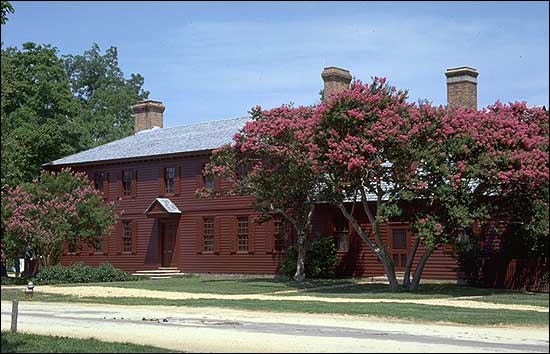
I can't help but think of another house that has fared much more happily. Belonging to distant cousin (and similarly named) Peyton Randolph, the house, right, was built at nearly the same time in the 18th c and in a similar style, and was also funded by tobacco-money. But the Peyton Randolph House was built in Williamsburg, where it became part of Colonial Williamsburg with its future secured by Rockefeller money, while less than a hudred miles away, the Brockenbrough-Peyton House languishes in Port Royal.

Location, location, location....

Left: Brockenbrough-Peyton House, Port Royal, VA
Right: Peyton Randolph House, Williamsburg, Va. Photo courtesy of Colonial Williamsburg Foundation.