Saturday, July 9, 2011

Breakfast Links: Week of July 4, 2011

With Independence Day to begin the week, this selection of Breakfast Links has a definite patriotic flavor.  But you’ll also find everything from 16th c. armour to 20th c. suffragettes in our collection of noteworthy tidbits gathered from other blogs, web sites, and news stories from around the Twitterverse.
Amazing 360 degree view of the Royal Pavilion's Great Kitchen: http://ow.ly/5w6HA
• Early 4th of July celebrations at the White House by Thomas Jefferson, others: U
A special treat on 18th c American dining tables (at least on George Washington's): robins! http://bit.ly/b2dffP
• Modern myth that needs debunking:African-American quilts used as secret codes by slaves on 19th c Underground Railroad: http://bit.ly/lLYwSr
• They certainly don't look like dangerous criminals: Suffragette Surveillance, 1913 - http://tinyurl.com/6y8nho2
• Currier, Carrier, Cottager: Occupations of the past: http://bit.ly/pcMyeG
• Gold script, rich and complex interlace; a magnificent example of Ottonian illumination http://ow.ly/5uCD6
• Some great seaside snapshots, taken in 1920s Ireland - http://wp.me/pd5mr-uD
• These shoes are made for dancing - and for music hall performer Kitty Lord (1920s) http://bit.ly/mSst9k
• An extraordinary French memento mori ivory rosary pendant, c.1500: http://bit.ly/qGydyU
• The inkily dark history of the Parc des Buttes Chaumont: http://t.co/B6p279D
• The Gilded Age lives on: A luxurious marble townhouse c1901 on NYC's Riverside Drive can be yours for $61.9 million! http://bit.ly/ptXipF
• For the best-dressed 16th c warrior: Costume Armour, German, c.1525 http://bit.ly/nVMxpW
• Much better than staring a computer screen on a summer day! Victorian ladies in fancy dresses go boating: http://tinyurl.com/3z3ke7g
• Have you no scruples? Understanding your 18th c apothecary's prescription. http://post.ly/2M8db
• The lunch counter as a vexed symbol in U.S. cultural history: http://bit.ly/owCxK2
• A history of pie and mash - Londoners and their eel pies! http://bit.ly/oM8Uga
• Some wonderful images of Marie Antoinette's Chateau, the Petit Trianon 

Thursday, July 7, 2011

The Brontë Sisters (a silly historical video by the History Girls)


We can't claim any special connection to these very funny British comedians except that we're all "history girls." As they say on their website: "The History Girls take their version of history and put a wig on it - a sort of Brontë Python." In this sketch, they put their silly-wig on the writing Brontë sisters. We especially like the part about coming up with a really, really good title – a constant challenge to novelists (okay, at least it's a constant challenge to us) though perhaps not with such amusing results. Oh, if only our books had moors in them, too!

Wednesday, July 6, 2011

Paris-London Steam Packet

Loretta reports:

Years of researching Regency era stories made me familiar with England's coaching roads, along which the mails sped.  To get to France, one generally traveled the road to Dover.  From there, sailing packets crossed the Channel to Calais, France, a distance of approximately 30 miles.

Though I knew my hero and heroine in 1835 would travel under steam power,  I hadn’t realized, until I studied travel guides for the period, that it was possible to go from Calais to London by boat.
~~~
ROUTE BY STEAM PACKETS.
The route by the London Steam Boats from the Tower Stairs, is less expensive, and, during the summer months, preferred by many. Those who are not subject to sea-sickness, will find this route, in fine weather, a most delightful voyage ; the vast variety of objects it affords, the crowds of shipping through which you imperceptibly glide, castles, barges, trees, in short, every object calculated to excite admiration and heighten enjoyment, present themselves, during your passage through the Thames. The Steam Company usually print monthly lists, stating the time of their leaving both London and Calais . . . In favourable weather, the passage is made in about twelve hours, but sometimes they are from sixteen to eighteen; the fare for best cabin passengers, is 33s.; fore cabin, 1£. 2s. 6d.; refreshment may be had on board at the following prices: breakfast consisting of cold meat, eggs, tea and coffee, 2s. dinner of plain roast and boiled, with vegetables, &c. 2s.; tea, 1s.; bottled porter, 1s.; wine, spirits, &c. equally reasonable, and of the first quality; there are beds on board, and every accommodation for ladies . . . Gentlemen who prefer travelling in white hats, will do well to wear either a hat cover, or a travelling cap, whilst on board the packets, as the smoke from the funnel of the vessel will discolour it.
__ Francis Coghlan, A guide to France, explaining every form and expense from London to Paris, 1830.

Print illustration:  The steam ship President in gale, courtesy Wikimedia Commons.
Photo:  Detail of an image from the Illustrated London News (10 May 1851), a cutaway of a packet ship, displayed at the Smithsonian; photo courtesy me.

Tuesday, July 5, 2011

Silver Gilt Extravagance for a Titled Bride, c.1680

Susan reporting:

Aristocratic marriages of the past were more often calculated unions of fortunes and political allies than affairs of the heart. Estates, great houses, incomes, and investments were the most valuable assets in pre-wedding negotiations, but an aristocratic bride could also bring more personal items of great value to the match. Her parents could generously launch her into marriage with a costly new wardrobe and jewels, plus furnishings for her private quarters.

This elaborate toilet service was likely made for a high-born English bride in the late 17th c. by master London silversmith William Fowle. The set is silver-gilt – silver plated with gold – richly engraved with Chinese-inspired designs, and includes a large looking-glass, candlesticks, boxes, caskets, salvers, a trimmer for candle-wicks, and a pin cushion. So lavish a set, with so many pieces, showed the bride was not only a lady of taste but of leisure as well, able to devote hours each day to herself and her appearance.

But silver pieces were not only for show. They were a tangible display of wealth, crafted from precious metal that could be easily liquidated in an emergency – which makes it especially noteworthy that this one has survived. A toilet service such as this would have been a valuable (and perhaps comforting) asset for any affluent bride.

Mary Evelyn (1665-1685) was the talented daughter of John Evelyn (1620-1706), a prominent scientist, writer, and courtier in 17th c. England (last seen on our blog promoting the consumption of salads here.) Mary's poem Mundus Muliebris, or The Woman's World was a satiric listing of all the things an extravagant young lady of fashion required before she could embark into "Marry-land." One section describes a toilet service much like this one:
   ...Implements,
   Of Toilet, Plate Gilt, and Emboss'd,
   And several other things of Cost:
   The Table Miroir, one Glue Pot,
   One for Pomatum, and what not?
   Of Washes, Unguents, and Cosmeticks,
   A pair of Silver Candlesticks;
   Snuffers, and Snuff-dish, Boxes more,
   For Powders, Patches, Waters store,
   In silver Flasks or Bottles, Cups
   Cover'd, or open to wash Chaps;
   Nor may Hungarian Queen's be wanting, 
   Nor store of Spirits against fainting:
   Of other waters rich, and sweet,
   To sprinkle Handkerchief is meet....

Here's the link to the entire poem, if you'd like to read all the expectations of a 17th c. Bridezilla, from chocolate pots and romances to a "Pompous Coach."

Above: Toilet Service by William Fowle, English (London), 1683-84, Metropolitan Museum of Art. Photography copyright 2011 Susan Holloway Scott.

Monday, July 4, 2011

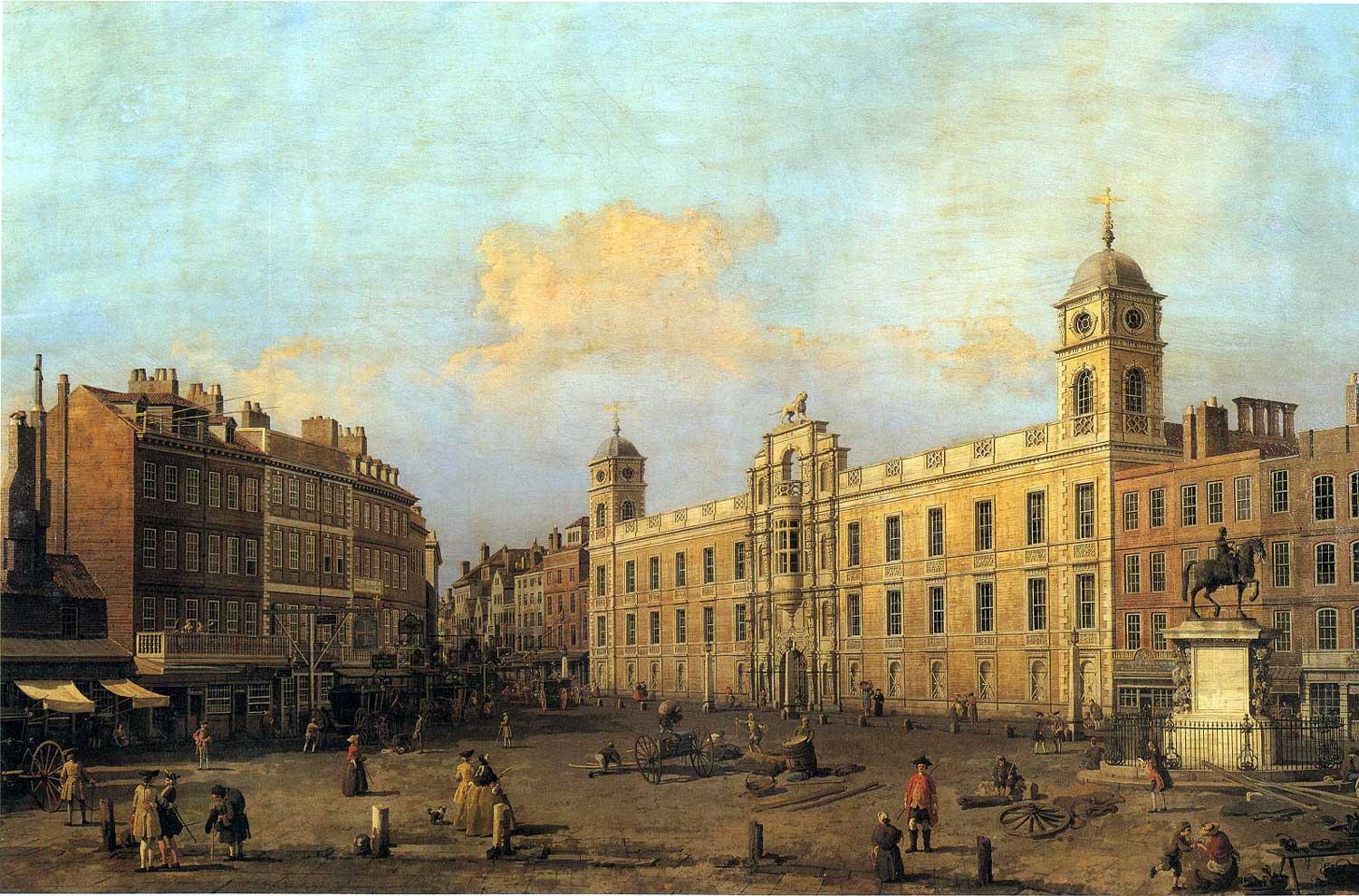
Northumberland House: The Last Mansion in the Strand

Loretta reports:

My aristocratic characters often live in adapted versions of non-fictional houses.  This is the case with Silk is for Seduction's Duke of Clevedon, upon whom I bestowed a slightly altered version of Northumberland House, a splendid Jacobean structure situated unfashionably (in 1835) on the Strand.

The house caught my fancy, partly because of its location but mostly because of the way it looked.  As this Canaletto painting shows, it’s absolutely not Georgian.  There was nothing neoclassical or Adams-ish about it.

In the time of my story, this area was undergoing transformation into Trafalgar Square.  It still manages to look very romantic by moonlight, in this painting, shortly before its demolition.  It was not taken down because it was falling apart, but to make way for a street, though—if the various protests to its destruction had it right—there was a perfectly good street nearby that only wanted widening.

Imagine my excitement, then, when my visit to the Victoria and Albert Museum brought me to one gorgeous remnant of its glory days.  Along with this doorway of its Glass Drawing Room was a miniature of the room.  Oddly enough, the reflected light (it’s not easy to photograph objects behind glass, in a dark room) does help us see what long-ago family and guests would have seen, as they gathered here in the evening before or after dinner.

Photos copyright 2011 Loretta Chekani
(You'll find more views of the room and the doorway at Loretta Chase In Other Words.)

Sunday, July 3, 2011

The First Independence Day, 1776


Susan reporting:

In this age of instant communications, when participants and observers can tweet simultaneous reports of momentous events to followers around the world, it can be difficult to realize how long it took to spread word of the newly-signed Declaration of Independence. The members of the second Continental Congress approved the final wording of the Declaration on 4 July 1776, but many historians now believe that it wasn't completely signed by all the members until August.

The first reading to the public was in Philadelphia on July 8. Printed copies of the Declaration were sent as swiftly as possible to all the colonies, where they were read out loud as well as reprinted in local newspapers. But the colonies were spread far apart and roads were bad or often non-existent, and many colonists didn't learn the important news for weeks or even months. The British king and government from whom independence was declared had to wait even longer. Even the speediest of trans-Atlantic voyages took weeks in the 18th c., and it wasn't until mid-August that ordinary Londoners could read the Declaration for themselves in English newspapers.

In Massachusetts, far from Philadelphia, future First Lady Abigail Adams (last seen on our blog herelearned the news in a letter written by her husband John Adams on 3 July 1776. While in the excerpt below, John correctly predicted that the signing would be forever celebrated by the new country, Abigail must have had at least a few misgivings as she read John's letter. In those early days of rebellion, all the men who signed the declaration were considered traitors by the King of England. There was now a reward offered for her husband's capture, and with his signature, he had pledged his life, his family's welfare, and his fortune for the sake of independence and freedom: a very high price, indeed.

The second day of July, 1776, will be the most memorable epoch in the history of America. I am apt to believe that it will be celebrated by succeeding generations as the great anniversary festival. It ought to be commemorated as a the day of deliverance, by solemn acts of devotion to God Almighty. It ought to be solemnized with pomp and parade, with shows, games, sports, guns, bells, bonfires, and illuminations, from one end of this continent to the other, from this time forward forever more.

Left: Declaration of Independence, 1776
Right: Drummer Boys in Revolutionary War-era Uniforms, Colonial Williamsburg, photo copyright Susan Holloway Scott

Saturday, July 2, 2011

Breakfast Links: Week of June 27, 2011


A special welcome to all our new followers on Blogger and Twitter, and best wishes to our old friends, too. It’s a holiday weekend here in America, and we’re glad you’re sharing your Fourth of July with us. We’re serving up a tasty selection of Breakfast Links this week, gathered for your amusement from various websites, blogs, and tweets.
 Wonderful collection of late 19th c photos of smiling subjects - last sequence of man & woman is esp. delightful: http://bit.ly/gxzY5K
• Spurious but amusing tale of 19th-century smuggling: http://bit.ly/kM0RQ0
• Rescue & rebirth of 19th c NYC department store Ehrich Brothers: elegant commercial building preserved, reused: http://bit.ly/m4Zppb
• Beautifully combining art & botany:18th c. flower collages by Mary Delany http://bit.ly/jcDkxH
• Travel in 18th c high style! It's a SEDAN-tary life: http://post.ly/2HvZc
• Ancient architecture and heraldic symbolism: 360˚ virtual tours of St George’s Chapel, Windsor http://bit.ly/kiBMkq
• These need no comment: Vintage Ad Sexism - http://tinyurl.com/62ashbn
• Alice B. Toklas stitched Picacasso's designs: Amazing needlepoint upholstery on Louis XV chairs: http://bit.ly/igqZBn
• The Abduction of Frances Mercer, 1750 - a story of Georgian child kidnapping http://bit.ly/joTTWT
• Emily Dickinson's Bible posted online by Houghton Library, Harvard University, Cambridge, Mass : http://tinyurl.com/68nnw5x
• Mary Saxby (1738-1801): the girl who ran away with the gypsies: http://bit.ly/m6x1hZ
• Long before the Duchess of Cambridge visited Canada, the young Queen Elizabeth wore this: "Maple Leaf" Dress from state visit in 1957: http://ht.ly/5ucDI
• Just in time for the 4th: View each signature on the Declaration of Independence. http://bit.ly/jxbaAe
• Gorgeous Chiswick House: http://wp.me/p13rlt-PM Beautiful local Georgian temple/villa, self-contained folly .
• Totally steampunk: Victorian artificial arm: http://bit.ly/k8TmAs
• When an 18th c brick house is really covered with tiles: Mathematical tiles http://tinyurl.com/3utatok
• One of the most extraordinary pieces of Tiffany's jewelry http://met.org/mhECee , featuring dragonflies & dandelions.
• Shoes from 70 yrs ago that could hit the fashion-streets today: Shoe Design c. 1939 - http://tinyurl.com/6x8bhx7
• Oakwell Hall, lovely but modest 16th c W. Yorkshire country house that inspired Charlotte Bronte: http://bit.ly/lFMmeZ