Thursday, January 7, 2010

One More Little Corset


Susan reports:

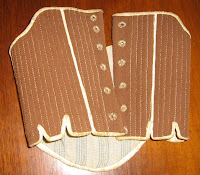
Here's one more example of 18th c. child-sized stays as reproduced by the mantua-makers of Colonial Williamsburg. (These are the same stays mentioned by our reader Abby, a former intern in the shop, who remembered showing them to fascinated visitors.) These really are tiny, sized for an infant, and stiffened not with baleen, but with pasteboard – we'd call it cardboard. The lacings are on the back of the stays.

Wednesday, January 6, 2010

Teeny Tiny Corsets

Susan reports:

Whenever we discuss corsets or stays (as they are called in the 18th c.), we're usually referring to the ones that adult women wore to give them fashionable shapes, and "improve" on Nature. But ladies weren't the only ones who began the day with a tight lacing. Most well-bred European children, girls and boys alike, also wore stays from the age of three months onward. 

The goal was not narrowing the waist, but to encourage proper posture and make standing straight a lifetime habit.  You know, being "upright" and "upstanding."

Costume collections have many of these tiny corsets, some measuring only sixteen inches around the chest. (The example, left, is a recreation by the Colonial Williamsburg mantua-makers; here's an antique example from the CW collection, and another from a private 
collection.) They're substantial, no-nonsense garments, quilted layers of stiffened linen and buckram, reinforced with baleen boning. The two young children in the painting below are clearly wearing stays beneath their fashionable clothing.

By the time boys were ready for breeching at about age five, they put aside stays along with the rest of their uni-sex baby clothes,
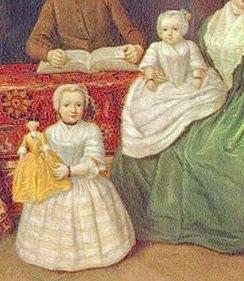
and began to dress like miniature men. Girls never gave them up; ladies wore stays their entire lives, even while pregnant. The girls of the later 18th c. did have the advantage of reaching womanhood in the brief era of the high-waisted Regency styles, and would have been spared whalebone for twenty years or so of their lives. But one wonders if the famously willowy figures of the time resulted from the stays worn as children.

To modern parents, the idea of toddlers in corsets seems horrifying. But every generation has its own ideas for raising healthy children. Those of us of a certain age (cough, cough) will recall the peculiar emphasis put on "correcting and supporting" children's feet in the 1950s and 60s. Kids were weighed down by clunky, reinforced oxford-style shoes with rigid arch inserts and tight lacing over the top of the foot. The more things change....


Tuesday, January 5, 2010

Department of Quotation: Twelfth Night (6 January)

Loretta reports:

From The Every-day Book, by William Hone, published 1827

To explain, to those who may be ignorant of the practice. On Twelfth-night in London, boys assemble round the inviting shops of the pastrycooks, and dexterously nail the coat-tails of spectators, who venture near enough, to the bottoms of the window frames; or pin them together strongly by their clothes. Sometimes eight or ten persons find themselves thus connected. The dexterity and force of the nail driving is so quick and sure, that a single blow seldom fails of doing the business effectually. Withdrawal of the nail without a proper instrument is out of the question; and, consequently, the person nailed must either leave part of his coat, as a cognizance of his attachment, or quit the spot with a hole in it. At every nailing and pinning shouts of laughter arise from the perpetrators and the spectators. Yet it often happens to one who turns and smiles at the duress of another, that he also finds himself nailed. Efforts at extrication increase mirth, nor is the presence of a constable, who is usually employed to attend and preserve free "ingress, egress, and regress," sufficiently awful to deter the offenders.

If you read the e-text, you'll see, further down, mention of Twelfth-cakes.  Colonial Williamsburg offers a recipe. And here's a BBC story, complete with wrong date (????)

Monday, January 4, 2010

Beautiful Regency corset


Loretta reports:

Some years ago I learned that, contrary to popular belief, corsets were not necessarily uncomfortable.  I'll explain some exceptions in another post.  But for now let's say that, generally speaking, given the materials used, the lacing could be tightened only to a point.  Later in the century, tougher materials, including metal, were used, which allowed extremely tight lacing, à la Scarlett O'Hara.

I'll have more to say about corsets in relation to an exhibition I visited recently.  Meanwhile, though, I wanted to share my photos of this beautiful Regency corset, created by the milliners at Colonial Williamsburg.

Historian Janea Whitacre holds up a corset that might have been worn under the red dress I showed yesterday.  I think the first photo shows that this wasn’t a torture device.  The busk, which is clearly visible, would take some getting used to, but the corset itself is soft and silky to the touch.  I suspect it would more comfortable than a bra with an underwire.

Notice the wide straps.  This is a far cry from the strapless Victoria’s Secret-type corsets which frequently adorn the covers of romances.  Furthermore, the corset is not worn against the skin, but over one’s shift or chemise.

You can see that the holes for the lacing are reinforced with thread.  No metal grommets.

You may want to compare and contrast this ca 1815 corset with 18th C stays. (Scroll down to Stays and click for pop-up.)

Sunday, January 3, 2010

Beautiful Red Dress


Loretta reports:

I thought we could start off the new year with a beautiful red dress.*

This one, which was made at the Colonial Williamsburg Milliner’s Shop, is a copy of a dress worn to a congressional party about 1813-1817 by a Virginia congressman’s wife. Since I often need to dress and undress my heroines, the clothing fastenings are endlessly fascinating to me. The back fastenings are tapes as well as metal hooks which hook onto threaded loops.


Making the red cotton dress, we were told, took 10-12 hours. The white cotton embroidery took 13 weeks. One interesting thing we learned was that fancy embroidery work was often done by the customer, rather than the milliner. Embroidery, after all, was an occupation for ladies. Furthermore, it would add considerably to the expense of the dress.

I believe this would be the case for gentlewomen in England as well, but it would depend on their rank and wealth. While Jane Austen and her relatives might embroider their own dresses, I strongly doubt that stupendously wealthy aristocratic women in London would. Would it be work for one or more of their maids? Maybe. I’m not sure. Even the wealthiest Americans did not, so far as I can determine, begin to approach the income levels of England’s noblemen until the time of the robber barons, later in the 19th C. For many aristocratic ladies in early 19th C England, money was no object, and I can easily imagine the embroidery being left to the modiste and her assistants.

*Lyrics

Saturday, January 2, 2010

Update: Mrs. Newton's Gown, Finished

Susan reports:

Many of you will recall our series of blogs this autumn that followed the creation of an 18th c. gown by the mantua-makers of Colonial Williamsburg. It took three blogs to show all the steps of the fittings (here, here, and here
-- quite an undertaking! The gown still wasn't
completed when we left in October, and so I was delighted to see it finally finished and on display in the Margaret Hunter shop at Christmas.
Here it is, left, now with the appropriate lace-edged sleeve ruffles and trim in place, and a most lovely garment it is, too.

For comparison, here's the portrait, right, that inspired the gown: Mrs. Newton by Thomas Durand; collection of Colonial Williamsburg, gift of M. Knoedler.

Friday, January 1, 2010

Christmas in Colonial Williamsburg: Finale


One last glimpse of the holiday wreaths of Colonial Williamsburg! While Twelfth Night would have been the traditional close of the 18th c. Christmas season, for us in the 21st c. it ends today, on New Year's Day. All the decorations will be put away, and we TNHG will resume our usual posting with the new week.  

Some of you have commented on how (relatively) deserted CW appears in these holiday pictures. That's because they were taken very early in the day, before most visitors had left their hotel beds, or at least the local pancake houses. For those of us who love the romance of the past, it's much better like this. On a sunny afternoon during the Christmas season, Duke of Gloucester Street can be as cheerfully crowded and bustling as any modern shopping mall, and where's the romance in that?

But when the sun is still low in the sky and the streets are empty of modern folk, it's easy to slip back into the past, and wonder exactly what is being whispered here in this rendezvous beneath the brick arches of the Capitol....

Happy New Year!
Loretta & Susan