Susan reports:
"Intrepid" doesn't begin to describe the character and life of Ann Ford Thicknesse (1737-1834). Genteelly born, her father indulged her with an excellent education (she spoke several languages) and extensive music lessons. She soon displayed a rare talent for music and sang beautifully, as well as playing several instruments.
But while her father encouraged her in concerts for friends, he forbid her to perform on the stage. They quarreled so violently that she moved from home and into the house of a friend, announcing that she would support herself by her music. Her furious father had her arrested and hauled back home. Undeterred, she arranged a series of subscription concerts, and her father hired ruffians to disturb her first theatrical performance. Only the intervention of one of her aristocratic supporters permitted the show to go on.
Her concerts were a sensation, and made her a celebrity. Among other instruments, she played the viola da gamba, scandalously (properly) positioning the viola between her knees. More scandal followed when she had her portrait painted by friend Thomas Gainsborough (1727-1788 ), himself an amateur musician. Shown with her instruments, her pose – with her legs crossed at the knee like a man – shocked society almost as much as her independent, intelligent gaze looking to one side that ignored the viewer. Handsome though she was, there was clearly none of the melting, doe-eyed society beauty about Ann.
The Earl of Jersey was smitten, and proposed that Ann become his mistress for a sizable annual sum and the promise to wed her when his ailing wife died. Indignantly she refused, and in defense of the rebuffed earl's attempts to slander her, Ann published A Letter from Miss F--D, addressed to a Person of Distinction in 1761. In it, she argued that "a young woman may sing in public...or be a public singer, with virtue and innocence." Over 500 copies were sold the first week, and the letter was also published in the Gentleman's Magazine. The earl's rebuttal, A Letter to Miss F--d, was not nearly as popular.
After performing in London and in Bath, she traveled to Suffolk with her good friend Elizabeth Thicknesse, who sadly died soon after in childbirth. Six months later in 1762, Ann married her friend's widower, Captain Philip Thicknesse (last seen in the TNHG writing travel guides.) The match raised eyebrows: not only was Philip twenty years Ann's senior, but he drank, whored, gambled, and took laudanum to infamous excess. He was litigious, quarrelsome, and an open supporter of slavery, and his personality was so irascible that he was known as "Dr. Viper." He wrote ferociously and often slanderously, on subjects as wide-ranging as male-midwifery to fraudulent automatons.
Yet it was a most happy marriage for nearly thirty years. The couple traveled extensively through Europe. Their eccentric entourage included not only a parakeet, but a monkey who was dressed in livery and rode postillion before their carriage; Ann's personal luggage included her viola, two guitars, and a violin. She also began writing and publishing books of her own, including works on playing the guitar and glass harmonica, travel, a novel, and, in 1778, the three-volume Sketches of the Lives & Writings of the Ladies of France.
Undeterred by the French Revolution, Ann and Philip were traveling to Paris in 1792 when Philip suffered a seizure and died in Ann's arms in their carriage. Griefstricken, Ann buried him in Boulogne, but before she could return home, she was arrested as a foreigner and imprisoned for eighteen months. She was finally released by proving that she was no idle, unattached gentlewoman, but could support herself –– as a musician.
Returning to England, Ann continued to write and publish. In 1806, when she was 68, she was described as "the most singular, and if it may be added, the most accomplished woman of her day." How can we argue with that?
Click here for more about Ann and one of her favorite instruments, the glass harmonica.
Above: Mrs. Philip Thicknesse, nee Ann Ford, by Thomas Gainsborough, 1760, Cincinnati Art Museum
Thursday, April 22, 2010
Wednesday, April 21, 2010
Strange & Beautiful Shoes
Loretta reports:
The first third of the 19th century, the setting of my books, offers all kinds of entertaining & fascinating apparel. But not so much the shoes. So far as I can ascertain, they were all flat soled, and came in two styles: half-boots or ballet slippers. This was the case, even in the 1830s, when women's fashions became flamboyant to a nutty degree. As Rachel of the FIDM Museum blog explains in her post about these beautiful evening boots, flat shoes remained in fashion well into the century.
We often hear people decry high-heeled shoes as bad for the back and knees. But early 19th century shoes, with their thin soles, wouldn’t win any prizes from podiatrists, either. (Not long ago, I heard one lecture at length about the evils of flip-flops.) And as pretty as the flat shoes might have been, I would vastly prefer more variety in the up and down department.
You can imagine my delight, then, when I discovered Toronto, Ontario’s Bata Shoe Museum and its 10,000-plus shoes. This newspaper article focused on their exhibition of platform shoes —a footwear fashion dear to my heart, because it let me be deliciously tall and tower over men—or at least look them in the eye.
The slap-sole shoes in particular fascinated me. If any historical dress experts want to hold forth about them, please feel free. And if any of you has a theory about why the flat shoe stayed in fashion for so many decades in the 19th century, you are in the unique position of having, here at 2NHG, the kind of audience who actually wants to hear it.
And for those who haven't had enough shoes, here's the antithesis of the Regency ballet-style shoe.
At lower right is a shoe I absolutely love, dated 1909-1914, and courtesy the Library of Congress Prints and Photographs Division Washington, D.C. 20540. You can find the complete record here.
The first third of the 19th century, the setting of my books, offers all kinds of entertaining & fascinating apparel. But not so much the shoes. So far as I can ascertain, they were all flat soled, and came in two styles: half-boots or ballet slippers. This was the case, even in the 1830s, when women's fashions became flamboyant to a nutty degree. As Rachel of the FIDM Museum blog explains in her post about these beautiful evening boots, flat shoes remained in fashion well into the century.
We often hear people decry high-heeled shoes as bad for the back and knees. But early 19th century shoes, with their thin soles, wouldn’t win any prizes from podiatrists, either. (Not long ago, I heard one lecture at length about the evils of flip-flops.) And as pretty as the flat shoes might have been, I would vastly prefer more variety in the up and down department.
You can imagine my delight, then, when I discovered Toronto, Ontario’s Bata Shoe Museum and its 10,000-plus shoes. This newspaper article focused on their exhibition of platform shoes —a footwear fashion dear to my heart, because it let me be deliciously tall and tower over men—or at least look them in the eye.
The slap-sole shoes in particular fascinated me. If any historical dress experts want to hold forth about them, please feel free. And if any of you has a theory about why the flat shoe stayed in fashion for so many decades in the 19th century, you are in the unique position of having, here at 2NHG, the kind of audience who actually wants to hear it.
And for those who haven't had enough shoes, here's the antithesis of the Regency ballet-style shoe.
At lower right is a shoe I absolutely love, dated 1909-1914, and courtesy the Library of Congress Prints and Photographs Division Washington, D.C. 20540. You can find the complete record here.
Tuesday, April 20, 2010
Men Behaving Badly: Captain Thicknesse Offers a Warning
Susan reports:
As more and more 18th c. Englishmen began traveling to the Continent for both pleasure and business, guidebooks were published to answer every question regarding a foreign journey. One of the most popular of these books was written by Captain Philip Thicknesse (1719-1792.) A minor military officer as well as an opinionated author known for his often eccentric views, Capt. Thicknesse believed firmly in the superiority of all things English, and the suspiciousness of everything else that wasn't.
The theme of the captain's guidebook, published repeatedly in the later 18th c., can best be summarized by the book's complete title: The Gentleman's Guide in his Tour through France, wrote by An Officer, Who lately travelled on a Principle which he most sincerely recommends to his Countrymen, viz. Not to spend more Money in the Country of our natural Enemy, than is requisite to support, with Decency, the Character of an ENGLISHMAN.
Here's a typically inflammatory sample:
Having hinted at the affability of the [French] ladies, I think it may be highly necessary to advise you to be extremely cautious in your amours (if any you propose.) The air of the southern parts of France is warm and impregnating. Consequently the women are extremely amorous, and the majority of them have it in their power to confer upon you a certain favour, which if it does not cost you your life, may stick by you all your days; it being reputed to be equally destructive as that of the Neapolitans. The surgeons here make a very serious affair of such an accident, and will run you up a bill of fifty guineas before you can look round you; so that a misfortune of this nature will throw your frugality out of the window, and set your constitution on the wreck. You will no doubt be frequently accosted in the streets, by fellows who are lookers-out to bawdy-houses, asking you if you want a jolie fille. And happy are they, when they can lay hold of an Englishman, [for] as these girls say, they bleed freely. Their reward on those occasions, [should be] to break your cane over their shoulders; for many unguarded foreigners have been seduced by those notorious villains, into places from whence they have never more made their appearance.
If you'd like more of his advice, the fourth edition of The Gentleman's Guide (printed in 1770) can be downloaded here.
Above: Captain Philip Thicknesse by Nathaniel Hone, 1757
As more and more 18th c. Englishmen began traveling to the Continent for both pleasure and business, guidebooks were published to answer every question regarding a foreign journey. One of the most popular of these books was written by Captain Philip Thicknesse (1719-1792.) A minor military officer as well as an opinionated author known for his often eccentric views, Capt. Thicknesse believed firmly in the superiority of all things English, and the suspiciousness of everything else that wasn't.
The theme of the captain's guidebook, published repeatedly in the later 18th c., can best be summarized by the book's complete title: The Gentleman's Guide in his Tour through France, wrote by An Officer, Who lately travelled on a Principle which he most sincerely recommends to his Countrymen, viz. Not to spend more Money in the Country of our natural Enemy, than is requisite to support, with Decency, the Character of an ENGLISHMAN.
Here's a typically inflammatory sample:
Having hinted at the affability of the [French] ladies, I think it may be highly necessary to advise you to be extremely cautious in your amours (if any you propose.) The air of the southern parts of France is warm and impregnating. Consequently the women are extremely amorous, and the majority of them have it in their power to confer upon you a certain favour, which if it does not cost you your life, may stick by you all your days; it being reputed to be equally destructive as that of the Neapolitans. The surgeons here make a very serious affair of such an accident, and will run you up a bill of fifty guineas before you can look round you; so that a misfortune of this nature will throw your frugality out of the window, and set your constitution on the wreck. You will no doubt be frequently accosted in the streets, by fellows who are lookers-out to bawdy-houses, asking you if you want a jolie fille. And happy are they, when they can lay hold of an Englishman, [for] as these girls say, they bleed freely. Their reward on those occasions, [should be] to break your cane over their shoulders; for many unguarded foreigners have been seduced by those notorious villains, into places from whence they have never more made their appearance.
If you'd like more of his advice, the fourth edition of The Gentleman's Guide (printed in 1770) can be downloaded here.
Above: Captain Philip Thicknesse by Nathaniel Hone, 1757
Monday, April 19, 2010
Regency era face-lift
Loretta reports:
Instead of a face-lift, here’s what you could do in 1811.
From The Mirror of the Graces; or, The English Lady's Costume by a Lady of Distinction, 1811
Illustration: A fashionable lady in dress & undress, color etching by Robert Dighton, 1807, courtesy Library of Congress Prints and Photographs Division Washington, D.C. 20540 USA
Instead of a face-lift, here’s what you could do in 1811.
Aura and Cephalus
[This curious receipt is of Grecian origin, as its name plainly indicates, and is said to have been very efficacious in preventing or even removing premature wrinkles from the face of the Athenian fair.]
Put some powder of the best myrrh upon an iron plate, sufficiently heated to melt the gum gently, and when it liquifies, hold your face over it, at a proper distance to receive the fumes without inconvenience; and, that you may reap the whole benefit of the fumigation, cover your head with a napkin. It must be observed, however, that if the applicant feels any head-ach, she must desist, as the remedy will not suit her constitution, and ill consequences might possibly ensue.
A Paste for the Skin.
[This may be recommended in cases when the skin seems to get too loosely attached to the muscles.]
Boil the whites of four eggs in rose water, add lo it a sufficient quantity of alum; beat the whole together till it takes the consistence of a paste. This will give, when applied, great firmness to the skin.
Illustration: A fashionable lady in dress & undress, color etching by Robert Dighton, 1807, courtesy Library of Congress Prints and Photographs Division Washington, D.C. 20540 USA
Sunday, April 18, 2010
Lost Lady Writers Found
Susan reports:
There's much talk of e-books in publishing these days, and of how the format will affect writers. But for long-forgotten writers, e-books and books on-line offer a literal life-line to modern readers, and their only chance to be rescued from dusty obscurity.
Women writers of the past are among the most neglected. While everyone knows Jane Austen, there were many others who were dismissed as "scribblers" in their time, and ignored by ours. Fortunately, there are libraries determined to change this. One of the more noteworthy is the Chawton House Library, whose mission is to promote the study and research of early English women writers. (It's a splendid coincidence that the beautiful Chawton House was also the home of Jane Austen's brother.)
The library's collections focus on writers from 1600-1830, and slowly but surely, they are putting more and more of these collection on line. How about dipping into The Princess of Cleves (1777) by the extravagantly named Marie-Madeleine Ploche de la Verne La Fayette? Or Paris Lions and London Tigers (1825) by Harriette Wilson, better known for her less literary endeavors?
Of course I had to check out the irresistibly titled Romance Readers and Romance Writers: a Satirical Novel (1810). The author, Sarah Green, is long neglected, but unjustly, as the opening paragraph shows:
"It is very strange," said Uncle Ralph, with evident impatience and vexation, as he threw down on the table with great force a romance of the last century, "that a writer must use so many words, only to tell us, that a woman got up and sat down again! No, they must inform us in high-flown-poetic language, that she rose from her mossy couch, and then thoughtfully reseated herself, and resumed her pensive posture! and then, if the wind happened to blow her thin clothes about, and made her ribbons flutter and fly, we must be entertained through half a page with her silk scarf floating in the wind and the rude zephyr discomposing her light and nymph-like attire!"
Personally, I'm hoping for the on-line version of another of Mrs. Green's novels: Scotch Novel Reading; or, Modern Quackery; a Novel Really Founded on Facts (1824).
Above: Mrs. Richard Bennett Lloyd by Sir Joshua Reynolds, c. 1775. Mrs. Lloyd elegantly carving her husband's name into the bark of the tree makes for a beautiful painting, if not for a very accurate one of a lady writing (though I doubt even Sir Joshua could make great art of a current lady-writer, hunkered down over her laptop.) But we'll let it stand in for Ms. Green, for whom, alas, I could find no portrait.
Digression alert: Mrs. Lloyd's picture, however, does turn up in the work of another, more famous women writer. In The House of Mirth
by Edith Wharton, heroine Lily Bart scandalously chooses to recreate the painting as a tableau vivant at a late 19th c. house party: "Deuced bold thing, to show herself in that get-up."
There's much talk of e-books in publishing these days, and of how the format will affect writers. But for long-forgotten writers, e-books and books on-line offer a literal life-line to modern readers, and their only chance to be rescued from dusty obscurity.
Women writers of the past are among the most neglected. While everyone knows Jane Austen, there were many others who were dismissed as "scribblers" in their time, and ignored by ours. Fortunately, there are libraries determined to change this. One of the more noteworthy is the Chawton House Library, whose mission is to promote the study and research of early English women writers. (It's a splendid coincidence that the beautiful Chawton House was also the home of Jane Austen's brother.)
The library's collections focus on writers from 1600-1830, and slowly but surely, they are putting more and more of these collection on line. How about dipping into The Princess of Cleves (1777) by the extravagantly named Marie-Madeleine Ploche de la Verne La Fayette? Or Paris Lions and London Tigers (1825) by Harriette Wilson, better known for her less literary endeavors?
Of course I had to check out the irresistibly titled Romance Readers and Romance Writers: a Satirical Novel (1810). The author, Sarah Green, is long neglected, but unjustly, as the opening paragraph shows:
"It is very strange," said Uncle Ralph, with evident impatience and vexation, as he threw down on the table with great force a romance of the last century, "that a writer must use so many words, only to tell us, that a woman got up and sat down again! No, they must inform us in high-flown-poetic language, that she rose from her mossy couch, and then thoughtfully reseated herself, and resumed her pensive posture! and then, if the wind happened to blow her thin clothes about, and made her ribbons flutter and fly, we must be entertained through half a page with her silk scarf floating in the wind and the rude zephyr discomposing her light and nymph-like attire!"
Personally, I'm hoping for the on-line version of another of Mrs. Green's novels: Scotch Novel Reading; or, Modern Quackery; a Novel Really Founded on Facts (1824).
Above: Mrs. Richard Bennett Lloyd by Sir Joshua Reynolds, c. 1775. Mrs. Lloyd elegantly carving her husband's name into the bark of the tree makes for a beautiful painting, if not for a very accurate one of a lady writing (though I doubt even Sir Joshua could make great art of a current lady-writer, hunkered down over her laptop.) But we'll let it stand in for Ms. Green, for whom, alas, I could find no portrait.
Digression alert: Mrs. Lloyd's picture, however, does turn up in the work of another, more famous women writer. In The House of Mirth
Thursday, April 15, 2010
Cabinet dressing-case
Loretta reports:
I was looking for something else when I came upon this in the 1824 Ackermann's Repository. It's typical of some of the ingenious furniture of the time—"ornamental and useful."
The annexed plate represents an elegant cabinet dressing-case: it is formed of fine mahogany, and richly carved. The lower part incloses a drawer, with wash-bason, ewer, &c. complete. The upper part contains three mirrors, in sliding frames and running on centres, with sundry divisions and cases for small and large bottles; the whole forming an ornamental and useful piece of furniture, suitable for a dressing or sitting-room. We have been kindly permitted by Mr. Durham to copy this handsome piece of furniture at his manufactory, 26, Catherine-street, Strand.
I was looking for something else when I came upon this in the 1824 Ackermann's Repository. It's typical of some of the ingenious furniture of the time—"ornamental and useful."
The annexed plate represents an elegant cabinet dressing-case: it is formed of fine mahogany, and richly carved. The lower part incloses a drawer, with wash-bason, ewer, &c. complete. The upper part contains three mirrors, in sliding frames and running on centres, with sundry divisions and cases for small and large bottles; the whole forming an ornamental and useful piece of furniture, suitable for a dressing or sitting-room. We have been kindly permitted by Mr. Durham to copy this handsome piece of furniture at his manufactory, 26, Catherine-street, Strand.
Wednesday, April 14, 2010
Tasting (Chocolate) History
Susan reports:

It's not often that historical research involves eating chocolate, but we intrepid Nerdy History Girls will try almost anything in pursuit of the past. Which is why one of our favorite things about Colonial Williamsburg is the the 18th c. chocolate.
Chocolate became increasingly popular in 18th c. Europe. Served primarily mixed with milk or cream as a morning beverage (the way it is being enjoyed by this French family, left) or in coffee and chocolate houses, 18th c. style chocolate is a very different animal from modern sweetened chocolate. It's a more complicated flavor, full of spices: not exactly sweet, but not bitter, with undertones of anise, red pepper, nutmeg, and cinnamon.
In other words, it wasn't a kiddie drink with sugar and marshmallows, but a sophisticated "adult beverage", and an expensive, status-conscious one, too, since all cocoa beans were imported. Chocolate was also praised for its quasi-medical benefits. According to Dr. Quincy's Medical Lexicon in 1782, chocolate was "good likewise not only in all intentions as a nourisher, and a restorative, but as an emollient, by lubricating and relaxing the passages."

In one of those rare, glorious unions between history and commerce, Colonial Williamsburg has recently rebuilt Charlton's Coffeehouse on its original site through the support of Forrest and Deborah Mars of the Mars Corporation (you know, M&Ms, Snickers, Dove Bars, and other necessities of the writing life.) Mr. and Mrs. Mars have also sponsored academic studies of the history of chocolate, as well as a line of historic chocolate products that's for sale throughout the historic district.
The CW chocolate comes in slender, historically accurate cylinders that are dusted with cocoa, and sold in small, cloth, drawstring bags. And as Loretta and I discovered, it's quite addictive, and we both have lots of the little cloth bags to prove it, too. If you'd rather drink your chocolate (and yes, we did that as well), the last stop of the tour of Charlton's Coffeehouse is the kitchen. There visitors are offered a choice of 18th c. style coffee or chocolate – which, from the number of half-full little cups discarded in the trash barrel by the door, may be a little too unusual for the tastes of most modern visitors.
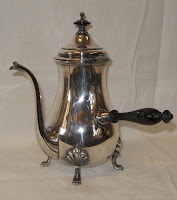
But not for us. We now understand entirely why 18th c. ladies couldn't begin their day properly without the ritual of the chocolate mill and pot (like the one, right), or why so many gentlemen adored their chocolate houses, and the chance to sip away the hours. Who wouldn't?
The CW chocolate comes in slender, historically accurate cylinders that are dusted with cocoa, and sold in small, cloth, drawstring bags. And as Loretta and I discovered, it's quite addictive, and we both have lots of the little cloth bags to prove it, too. If you'd rather drink your chocolate (and yes, we did that as well), the last stop of the tour of Charlton's Coffeehouse is the kitchen. There visitors are offered a choice of 18th c. style coffee or chocolate – which, from the number of half-full little cups discarded in the trash barrel by the door, may be a little too unusual for the tastes of most modern visitors.
But not for us. We now understand entirely why 18th c. ladies couldn't begin their day properly without the ritual of the chocolate mill and pot (like the one, right), or why so many gentlemen adored their chocolate houses, and the chance to sip away the hours. Who wouldn't?
In addition to eating historical chocolate, we read about it, too, and American Heritage Chocolate has a new book
. I have to admit I haven't read it (yet) but it's on my wish list, and I promise to dust the cocoa from my fingers when I turn the pages. And, as a freebie, here's a video about how 18th c. chocolate was made.
Above left: Le Dejeuner by Francois Boucher, 1739, the Louvre
Subscribe to:
Posts (Atom)