Tuesday, August 25, 2009

The Dog Ate Our Blog!

407px-Alfred_Dedreux_-_Pug_Dog_in_an_Armchair More precisely, the dog ate our List of Blogs We Read.

We woke this morning to find it gone, and though we searched high and low, it seems to have truly vanished. Of course we did not make a back-up, because we're Nerdy History Girls, not Nerdy Tech-Savvy Girls, and these things happen. To us, anyway.

So if your blog was one of the ones that vanished, please don't feel cheesed or put out with us. We just goofed, and we promise to rebuild our list, once we can get it back from this *&^%$ dog.

Pug Dog in an Armchair by Alfred Dedreux (1810–1860) Ain't he a beaut?

Sunday, August 23, 2009

1830s Dandies by Dickens

Loretta reports:

I've been doing one of my annual re-reads of Dickens. This time it was The Pickwick Papers. Plenty of laughs, lots of interesting historical detail, and some costume mysteries.

What, pray tell, are "Oxford-mixture trousers"? How about "plush shorts and stockings"? The following, though, I think will be easy for everyone to understand, after our recent Show & Tell.

'Well, I'll bet you half a dozen of claret on it; come!' said Wilkins Flasher, Esquire, resuming the conversation to which Mr. Pell's entrance had caused a momentary interruption.

This was addressed to a very smart young gentleman who wore
his hat on his right whisker, and was lounging over the desk, killing flies with a ruler. Wilkins Flasher, Esquire, was balancing himself on two legs of an office stool, spearing a wafer-box with a penknife, which he dropped every now and then with great dexterity into the very centre of a small red wafer that was stuck outside. Both gentlemen had very open waistcoats and very rolling collars, and very small boots, and very big rings, and very little watches, and very large guard-chains, and symmetrical inexpressibles, and scented pocket-handkerchiefs.

Shoes NOT Made for Walking

Venetian shoes: taller Susan reports:

In the description of the Two Nerdy History Girls, Loretta and I promised shoes. Today, we deliver history AND shoes.

A quick flip through the humungo fall fashion magazines shows that platform shoes are with us once again. As the Nordstroms website proclaims with breathless authority, "From coquettish embellishments to sky-high platform heels, fall's latest booties soar to new heights!"

Not so fast, Mme. Nordy.

The 2009 models seem positively squat compared toVenetian shoes these towering examples from 16th century Venice. Worn by the most exclusive courtesans in Europe, these sky-high mules were not only a way to set one's gorgeous self literally above mere mortal women, but they also made a dandy display of a courtesan's financial success. While the shoes themselves were expensive, as everyone knew, the real status came from the "accessories": the constant attendance of at least two servants to help the wearer keep her balance and carry her sweeping skirts. I wonder, too, how these women ever managed to maneuver in and out of gondolas without toppling into the canal, but then I suppose that's one more mysterious art of the courtesan that's been lost to history.

Friday, August 21, 2009

Another Tall, Dark, & Non-Peacock-ish Gentleman

Charles II w: pineapple cropped Susan reports:

Despite what Fashion dictates, there have always been plenty of gentlemen in every age who choose to go their own way, or at least choose to adapt the trends to their personal tastes. Certainly the dashing fellow with the pipe in Loretta's last post fits that bill, and I imagine Dain did, too.

I've further proof in King Charles II (1630-85), who features so prominently in my last four historical novels. (Look to my own blog to read more about him.) While most of Charles's court was sporting the latest is gaudy Parisian styles, Charles himself preferred simply cut dark clothes when he didn't have to don the ermine for state occasions. (Alas, not even he could escape those awful big, baggy petticoat breeches.) Charles even limited his everyday ornament to having the badges of the order of St. George and the Garter embroidered directly on the fronts of his coats, rather than having to wear the bejeweled versions. As one contemporary noted, "His dress was plain but very elegant and neat: no body wore his cloaths better."

Which is, of course, much easier to do when you're over six feet tall and athletically fit, like Charles. And Dain. And the gentleman in Loretta's post –– who is coincidentally standing in pretty much the same pose as Charles. Whoa!

On an entirely different note: I couldn't bring myself to crop out the little dog standing to the right of Charles. He's a genuine King Charles spaniel, and yes, this is THE King Charles for which the breed is named.

Wednesday, August 19, 2009

Not quite so girly


Loretta reports:

This is more like what I envisioned Dain wearing. But not the pipe, please. I like the background, though.

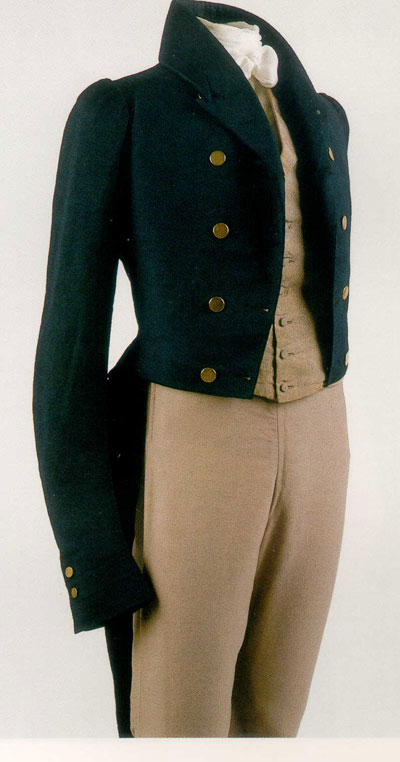
Here's an actual coat from the collection posted at the Republic of Pemberley. Not quite so frou-frou, I think, as the examples in fashion prints.

Peacock, Some More

Susan reports:

443px-Waist-and-Extravagance-ca-1830-fashion-satire-Heath I agree. Beau Brummel had a LOT to do with wringing the neck of the male peacock by insisting on colorless good taste. He didn't do it single-handedly, of course –– there's that whole grave, gloomy, righteously gloomy Victorian-man-thing looming right over the horizon, cheek to jowl with the grey Industrial Revolution –– but ol' Beau can take a goodly part of the blame.

But what struck me most about those 1830s fashion plates wasn't how plain the gentlemen's attire had become, but how similar the basic silhouette was to the ladies' whacky gowns. They both have the same wide, sloping shoulders, broad chests/breasts, and tiny waists. I know I've read that Prinny and other gentlemen of the time who struggled with avoirdupois-management resorted to corseting, but these guys would give Scarlett O'Hara a run for the smallest-waist prize. Then suddenly their coats billow outward like the ladies' bell-shaped skirts, and worse, those white trousers give them...hips. I mean, who doesn't know that white pants make one's butt look big?

This 1830s cartoon (aptly callled Waist and Extravagance) exaggerates to make its point, but it's not that far from the fashion-plates. Hmmm –– maybe Jessica should have been making fun of Dain's wardrobe, too?

Saturday, August 15, 2009

The demise of the peacock?

1814 Lodgings to let-w Loretta reports:

Funny how fashion changes. My new story required my moving out of the Regency into that no man’s land between 1820--when the Regent became King George IV--and 1837, when Victoria donned her crown and launched the Victorian era. I’m in late 1831, to be precise.

In the course of researching fashion, I noticed that while men’s dress remained relatively simple and form-fitting, women’s dress went berserk.

1831 Dandies-w Here are some gentlemen of 1831, the time of my story. Notice how the man in front doesn’t look all that different from the man in the caricature or the picture of Brummell in my previous blog. 1831 guy is showing more chest, but that’s partly the need of the fashion plate to show details. Generally, though he hasn’t grown much fancier in 25 years, and he’s still showing off his figure.

1831-October-02 Now check out some ladies of 1831.

I can’t help thinking that Brummell killed the male peacock. Is that something to regret?